

More than 400 million people are credit active in India. This number is approximately half of India’s working population and has at least one loan or an active credit card. With this rising number and very little understanding of loans, many people are struggling to keep up with their EMIs.
Be it a personal loan, home loan, car loan, or education loan, one must know how to calculate monthly EMI. In this blog, we will review and understand how to calculate monthly EMI, the factors that go into the calculation, and some useful suggestions on how to handle loans.
EMI stands for Equated Monthly Installment. It is the amount that one is supposed to pay every month to the bank or any other financial institution for a loan until the loan balance is cleared. It consists of two components: the principal and the interest charged on the principal. The total of these components is then divided by the tenure, that is, the number of months for which the loan is taken, to arrive at the monthly instalment or EMI.
The formula to calculate monthly EMI is:
EMI=P×R×(1+R)^N/(1+R)^N−1
Where:
- P is the principal loan amount.
- R is the monthly interest rate, which is calculated as the annual interest rate divided by 12 and then by 100.
- N is the loan tenure in months.
Here’s a quick rundown of the EMI formula:
- Principal Amount (P): This is the total loan amount borrowed from the lender.
- Interest Rate (R): The annual interest rate provided by the lender, which is divided by 12 to convert it into a monthly rate.
- Loan Tenure (N): The duration over which the loan will be repaid, measured in months
There are three main factors that affect an EMI; these are:
- Loan Amount: The bigger the loan you borrow, the higher your EMI will be.
- Interest Rate: A higher interest rate translates to a higher EMI.
- Loan Tenure: A longer loan term lowers your EMI (spreading the repayment over a longer period), but you’ll end up paying more interest overall.
All of these factors affect your EMI amount; loan amount and interest rates are directly proportional to your EMI, and loan tenure is inversely proportional. That means if you have a small loan amount, lower interest rate and longer loan tenure, you’ll have a lower EMI but more interest paid overall.
Strategies to Choose the Right EMI
Before choosing the right EMI, you need to keep a few things in mind; these are:
- Assess Your Repayment Capacity:
When calculating a manageable monthly EMI, do a rough calculation of the monthly salary or funds you would be receiving.
- Choose the Right Loan Tenure:
Understand your requirements and choose the tenure that best suits your financial condition and long-term goals. Find the balance that best suits your needs.
- Consider Prepayment Options:
If you have extra disposable income, you can settle your loan earlier to reduce the principal, which will, in turn, reduce the EMI or even the tenure of the loan. But do read the terms and conditions of your loan before you consider this option, as some loans have prepayment penalties.
- Negotiate Interest Rates:
If your credit score is good, you should approach multiple lenders and demand lower interest rates. It becomes easy to find a loan with a lower interest rate when your credit score is above 750.
- Avoid Multiple Loans:
The worst situation is when managing more than one EMI becomes difficult financially. It is recommended that you borrow only one loan at a time, and if you have many loans, try to combine them.
- Use EMI Calculators:
Many banks provide EMI calculators online to help people compare two or more loan offers from different banks and select the loan that is most suitable according to the eligibility criterion fixed by the person to be granted the loan.
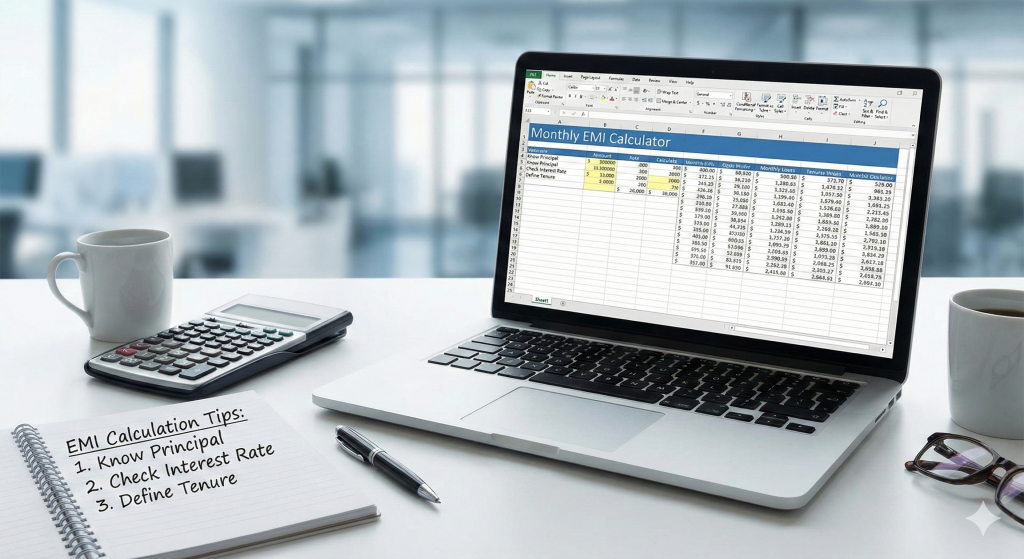
There are many EMI calculator options accessible over the internet that can prove beneficial in calculating EMIs. These calculators allow users to enter the loan amount, the rate of interest, and the duration required to determine the EMI immediately. They can also give an amortisation table that states how each EMI is divided between the principal sum and the interest charges for the whole loan period.
Understanding your EMI is important to set your future goals and stay on track. Here are a few benefits of knowing your EMI:
- Financial Planning: Knowing your EMI helps in better financial planning and budgeting.
- Loan Comparison: It enables you to compare different loan offers based on their EMIs.
- Avoiding Defaults: Being aware of your EMI ensures that you do not miss payments, thus avoiding defaults and maintaining a good credit score.
- Debt Management: Helps in managing your debt effectively by planning for prepayments and loan consolidations.
If you’re new to this EMI world, you should be very cautious; here are a few common mistakes that you should avoid as you enter this new realm:
- Overestimating Repayment Capacity: If you borrow beyond your capacity, you might be in a difficult spot.
- Ignoring Additional Costs: These include fees related to processing of the loan, early repayment fees, and insurance charges on the loan.
- Not Comparing Loan Offers: Neglecting the options may lead to high interest rates and other unfavourable terms of the loan.
- Neglecting Prepayment: Excluding the prepayment facility results in the borrower accumulating higher interest charges throughout the loan period.
It is crucial to determine the EMI correctly when it comes to availing the loan amount. It enables you to know your obligations and appraise your spending plan. Therefore, based on the principal amount, interest rate, and duration of the loan, you should choose the EMI that best suits your needs and plans.
Use available online EMI calculators to get quick and correct results for managing your loan repayment, as guided by the tips given above. Knowledge and control of EMI will help improve your financial position and prevent the stress of repaying the loan.
- What if I fail to pay my EMI?
Failing to pay EMI will incur late fees, lowered credit scores, and potentially higher interest rates.
- Is part-prepayment or foreclosure advantageous?
Yes, making part-prepayments or foreclosing the loan early can lower the principal, thereby lowering the EMIs or the length of the loan.
- Is it possible for EMI to remain constant during the tenure of the loan?
The EMI does not change for fixed-interest rate loans, while it varies for floating-interest rate loans based on changes in the market interest rates.
- When should I review my loan?
One should also check the loan terms annually or when the interest rates change to ensure that one is charged the ideal rate possible.
