How to Calculate SIP Returns in 3 Effective Ways
Confused about how to calculate SIP returns? Fret not. We cover 3 effective ways, tips and tricks and more to help you on this journey seamlessly.

Table of Contents
Today, many individuals are investing in mutual funds to create wealth over time through a Systematic Investment Plan (SIP). But the real question arises: what is the return that one can get on such investments? It is essential to have a clear idea about that before making wise financial decisions. Let us see these steps in an easy-to-understand way.
What is an SIP?
SIP stands for Systematic Investment Plan, an investment mode in which an individual invests a fixed amount at regular intervals in any mutual fund scheme. You can buy the mutual fund units on the same date every month. SIPs are very useful in smoothing out the buying cost because of a consistent approach towards investing and taking the benefit of compounding.
Why Calculate SIP Returns?
Knowing how to calculate SIP returns is essential to understanding how your investments perform. It helps determine whether the investment strategy is working perfectly or needs some changes. Proper return computation also allows for a good comparison between different mutual fund schemes.
Key Concepts to Grasp
Before we discuss how to calculate SIP returns, there is a need to learn about a few concepts, which include:
- NAV (Net Asset Value): It is the price per unit of a mutual fund, which changes according to the market value of its assets.
- Units Purchased: It is the number of units purchased through each instalment of SIP.
- Investment Tenure: This is the period for which you continue investing through SIP.
- Total Investment: The total value of investments made in this tenure.
- Current Value: The market value of the investment on the maturity date.
Different Methods for Calculating SIP Returns
Still wondering how to calculate SIP returns? There are several ways to calculate SIP returns. We’ll cover three common methods:
- Absolute Returns
Absolute returns tell you the absolute increase or decrease in your investment amount in a simple percentage. They’re the most basic method, but they don’t adjust for the time value of money.
Formula: Absolute Return (%) = (Selling price – Purchase price) / Purchase price) x 100
Let’s consider an example. Suppose an investor invests ₹1000 every month for 12 months, for a total of ₹12,000. The current value of the investment is ₹13,500.
Absolute return formula: (₹13,500 - ₹12,000) / ₹12,000 x 100 = 12.5%
- Annualised Returns (CAGR)
Compound Annual Growth Rate (CAGR) gives a much better perspective on returns as it factors in the period. It tells you the mean annual growth rate of your investments over a specified period.
Formula: (1 + Return) ^ (1 / N) - 1 = Annualized Return
Here, N is the time measured.
Let’s use the same example with a five-year investment period.
Scenario:
An investor decides to invest in a monthly SIP for 5 years. They invest a fixed amount of ₹5,000 every month. After 5 years, the total value of their investment becomes ₹3,25,000.
Calculating CAGR:
- Number of investment periods (N): In this case, N = 5 years * 12 months/year = 60 months (total number of monthly investments).
- Total Investment: Total investment = ₹5,000/month * 60 months = ₹3,00,000
- Total Return: Total return = Total value - Total investment = ₹3,25,000 - ₹3,00,000 = ₹25,000
- XIRR (Extended Internal Rate of Return)
The best and most exact method for calculating your returns on an SIP is this one. This method takes irregular cash flows and your investments on exact dates into account, so it is best for SIP calculations.
You can easily do the XIRR calculation with the help of any spreadsheet software like Microsoft Excel or Google Sheets.
Steps:
- List all your SIP investments with dates.
- Mention the current value of your investment with the respective date.
- And you will get the return using the XIRR function.
Here’s an example:
|
Date |
Amount |
|
01-Jan-2023 |
-1000 |
|
01-Feb-2023 |
-1000 |
|
01-Mar-2023 |
-1000 |
|
01-Apr-2023 |
-1000 |
|
01-May-2023 |
-1000 |
|
01-Jun-2023 |
-1000 |
|
01-Jul-2023 |
-1000 |
|
01-Aug-2023 |
-1000 |
|
01-Sep-2023 |
-1000 |
|
01-Oct-2023 |
-1000 |
|
01-Nov-2023 |
-1000 |
|
01-Dec-2023 |
-1000 |
|
31-Dec-2023 |
13500 |
Use the formula =XIRR(values, dates) in Excel or Google Sheets:
XIRR = XIRR({−1000,−1000,...,13500},{01−Jan−2023,01−Feb−2023,...,31−Dec−2023})
Interpreting the XIRR Result:
- This decimal value represents the internal rate of return (IRR) of your SIP investment.
- Multiply the XIRR result by 100 to get your SIP return as a percentage (CAGR).
Using Online SIP Calculators
The above process is usually cumbersome for most people, so nowadays, many SIP calculators are available online, where all one needs to do is enter the relevant details.
These calculators require you to input your monthly invested amount, the amount of time, and the rate of returns likely to prevail. It will calculate the return for you.
Tips to Get the Best SIP Returns
Here are some tips that can help you make the most of your SIP Investments:
- Regular Monitoring: Check on your investments at regular intervals to ensure you are on the right track.
- Reinvestment: Every inflow that you receive in terms of dividends should be reinvested to maximise your returns.
- Consider Inflation: Do not forget to consider the effect of inflation on your returns.
- Diversify: Don’t pool all your money into one fund. If you diversify, it lets you manage risk better.
Common Mistakes to Avoid
Let’s go through some common mistakes you should avoid when calculating SIP returns:
- Ignoring Fees: Remember to account for the fund’s expense ratio and other fees that it may charge because they reduce returns.
- Overestimating Returns: Try to be as realistic as possible with your rate of return to avoid disappointment.
- Neglecting the Time Factor: Different methods account for the time factor differently. Choose the correct method based on your needs.
Conclusion
We hope you finally have the answer on how to calculate SIP returns. Whether you use the absolute returns method for a quick calculation, CAGR for annualised returns or XIRR for the most accurate calculation, understanding these methods will help you make better investment decisions. Remember, investing is a long journey. Regularly monitoring and adjusting your strategy will ensure you reach your financial goals.
Ready to simplify SIP return calculations and make informed investment decisions? Use our free SIP calculator!
FAQs
- What is the formula for SIP returns?
The formula for calculating SIP returns is Amount invested × ({[1 + Periodic rate of interest] Total number payments – 1} / Periodic rate of interest) × (1 + Periodic rate of interest).
- What if I invest 3000 a month in SIP for 5 years?
If you invest 3000 a month in an SIP for 5 years, your total investment would be:
3000 x 60 = 180,000
Returns will depend on the rate of return of your chosen SIP.
- Is SIP risk-free?
No, SIPs are not risk-free. They are subject to market risks as they invest in mutual funds, which can fluctuate based on market conditions.
- Can I withdraw SIP at any time?
Yes, you can withdraw your SIP anytime. However, depending on your holding period, there may be exit loads or taxes.
Related Blogs
Published on Mar 26, 2026
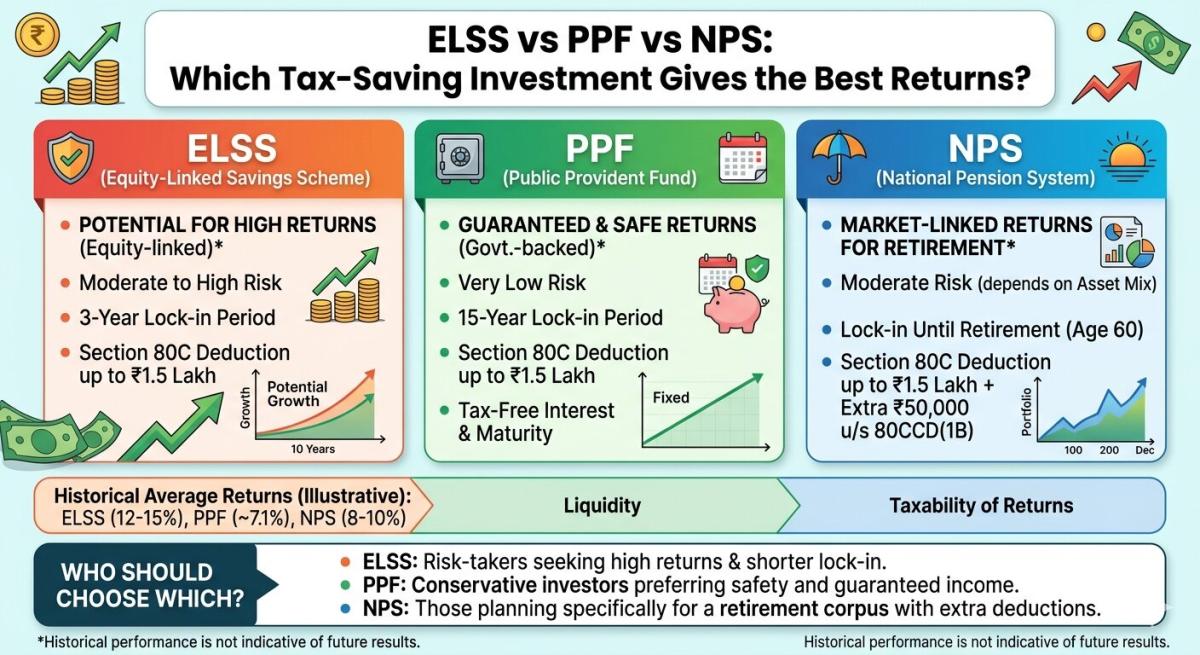
ELSS vs PPF vs NPS: Which Tax-Saving Investment Gives the Best Returns?
Compare ELSS vs PPF vs NPS to find the best tax-saving investment. Understand returns, lock-in periods, and features to choose what suits your goals.
Arjun Sharma
Content Lead – Banking & Payments

Published on Mar 26, 2026
How to Start SIP with ₹500 Per Month: Beginner's Guide to Mutual Funds
Learn how to start a SIP with ₹500 per month in mutual funds. Simple beginner’s guide to investing, building wealth, and growing money with small steps.
Arjun Sharma
Content Lead – Banking & Payments

Published on Mar 02, 2026
What is a Lumpsum Calculator and How Does It Work? Benefits, Accuracy & Planning Tips
Learn how a Lumpsum Calculator works, how it estimates one-time investment returns, and how to use it for smarter financial planning.
Priya Nair
Senior Compliance Editor at IFSC.co
Published on Mar 02, 2026
Mutual Fund Returns Calculator: How It Works, Accuracy & FAQs Explained
A Mutual Fund Returns Calculator helps you estimate the future value of your mutual fund investment using inputs like investment amount, tenure, contributions, and expected returns. It uses compounding to project potential growth and helps you plan smarter investment decisions.
Priya Nair
Senior Compliance Editor at IFSC.co

Published on Apr 10, 2025
Financial Planning: Using SIP Calculators Effectively
Confused about future finances? Learning how to use SIP Calculators can help you reach your goals! Invest small, grow big.
Priya Nair
Senior Compliance Editor at IFSC.co
calculate Financial Calculators
EMI Calculator
FD Calculator
GST Calculator
Lumpsum Calculator
Mutual Fund Returns Calculator
PPF Calculator
RD Calculator
SIP Calculator
SWP Calculator
article Latest Blog Posts
ELSS vs PPF vs NPS: Which Tax-Saving Investment Gives the Best Returns?
Compare ELSS vs PPF vs NPS to find the best tax-saving investment. Understand returns, lock-in periods, and features to choose what suits your goals.
SIP & Investing • 11 MINS READ
How to Start SIP with ₹500 Per Month: Beginner's Guide to Mutual Funds
Learn how to start a SIP with ₹500 per month in mutual funds. Simple beginner’s guide to investing, building wealth, and growing money with small steps.
SIP & Investing • 13 MINS READ
Senior Citizen FD Rates 2026: Which Banks Offer the Highest Interest?
Compare senior citizen FD rates in 2026 and find which banks offer the highest interest. Learn about returns, tenures, and tips to choose the best FD.
FD, PPF & Savings • 12 MINS READ
Sukanya Samriddhi Yojana (SSY): Interest Rate, Rules & Calculator Guide 2026
Learn about Sukanya Samriddhi Yojana (SSY) including eligibility criteria, required documentation, step by step application process, tax benefits explanation and comparison b/w SSY, PPF and FD
FD, PPF & Savings • 11 MINS READ
2 reasons why online banking is important in today’s COVID-19 situation
Discover why online banking became essential during COVID-19. Learn how digital banking ensured safety, convenience, and uninterrupted financial services.
Digital Banking • 4 MINS READ