SIP Explained: How SIP is Calculated for Indian Investors
Invest smart in India with SIPs! Learn how SIP is calculated, the benefits, and grow your wealth through cost averaging & compounding

Table of Contents
Investing wisely is the key to building a secure financial future. This is why Indian investors prefer mutual funds, which usually offer high returns compared to other conventional forms of saving. One favourite way to invest in mutual funds is through SIPs or Systematic Investment Plans.
When you adopt SIP, it imparts discipline and a methodical way of investing, even to a beginner just about to commence their investment venture. In this blog, we will cover the mechanics behind SIP and focus on how SIP is calculated and why it is indeed a prudent investment strategy.
What is SIP?
A Systematic Investment Plan (SIP) is a way of investing in mutual funds wherein an investor contributes a fixed amount at regular intervals–usually monthly or quarterly.
SIPs are supposed to make investors save and invest habitually without fail, irrespective of market conditions. Investing this way, investors can enjoy the benefit of compounding with time, which is the most significant way of wealth accumulation.
Components of SIP Calculation
To understand how SIP works, first, we must break it down into the key elements that drive the mechanics of how SIP is calculated:
- Amount and Frequency of Investment
The basic premise of SIP is a regular investment with a fixed amount. Investors can invest a fixed sum at their will to assist them in realising their financial goals or subject to their risk appetite. They can even invest in a mutual fund scheme on a monthly, quarterly, and even weekly basis.
Investing this way gives enormous flexibility to the investor with changing times and different investment objectives.
- Net Asset Value (NAV)
NAV is the per unit market value of the mutual fund scheme. It is determined by dividing the total value of all the securities in the fund's portfolio, net of liabilities, by the number of outstanding units.
NAV changes daily with the performance of the mutual fund's underlying assets. For SIP investors, NAV is an essential factor because it decides the price at which units will be allocated in each instalment.
- Units Allocated
When an investor pays a sum toward a particular date for a SIP, the amount is used to buy units of the relevant mutual fund scheme at the NAV prevailing on the SIP date. It is simply calculated as the invested amount divided by the NAV of that particular day for the units allocated.
So, in case it's a higher NAV, then it will result in the lesser allocation of units and, similarly, on lower NAV for the same amount of investment. If an investor does their SIP over time, then every time there is a change in the NAV, an investor just accumulates units; this way, the cost of investment gets averaged out.
Example of How SIP is Calculated
Let’s suppose an investor has decided to invest ₹5,000 monthly in a mutual fund scheme with an initial net asset value of ₹50. The following will be the allotments for the investor in the first month: Units allotted = 5000 / 50 = 100 units.
In the hypothetical case of improving the NAV to ₹52 in the second SIP, the investment of ₹5,000 will buy the following number of units: Units allotted = 5000 / 52 = 96.15 units. This process will be followed every SIP date as per the NAV on that SIP date.
Benefits of SIP Calculation
Knowing how SIP is calculated, several benefits make it an exciting investment method:
- It ensures investors stay disciplined and encourages them to invest regularly. This results in a savings approach, so wealth creation remains consistent over the long term.
- It benefits the investor with cost averaging and, therefore, ensures they receive the best possible returns. Since units are purchased at different NAVs over time, the per-unit cost is lower with an average price than lump sum investments when markets are high.
- Investment through SIPs reduces the impact of market volatility. SIP investors are less exposed to the market because their investments are averaged across every market level, thus reducing susceptibility in a high-low market scenario.
- Compounding SIP investments magnifies the power of compounding. Since returns generated on existing investments are ploughed back into the scheme, the potential for higher returns grows exponentially over time.
Conclusion
SIPs are a simple but effective investment strategy, be it for a new investor or an experienced investor in India. With the knowledge of how SIP is calculated, investors can decide rationally in line with goals and risk tolerance. SIP gives way to a structured format, enabling you to reach all your goals that will lead to financial prosperity. Initiate your SIP now and be on the road leading to a financially secure future.
Calculating SIPs lets you plan more effectively, taking into account compounding and growth over time. Use this IFSC's SIP calculator to determine your investment's future worth.
FAQs
- How do you calculate SIP with an example?
To calculate the SIP, divide the monthly investment amount by the mutual fund's NAV on the SIP date to determine the number of units purchased. For example, if you invest ₹5,000 monthly and the NAV is ₹50, you'll get 100 units (5000 / 50).
- How is interest calculated on SIP?
SIP investments do not earn interest like traditional fixed deposits. Instead, returns are based on the mutual fund's performance, which is reflected in the NAV. The growth in investment value depends on the NAV appreciation over time.
- What is ₹3,000 SIP for 5 years?
A ₹3,000 SIP for 5 years means investing ₹3,000 monthly in a mutual fund for 5 years. The final value depends on the mutual fund's performance and the cumulative NAV over the period.
Related Blogs
Published on Mar 26, 2026
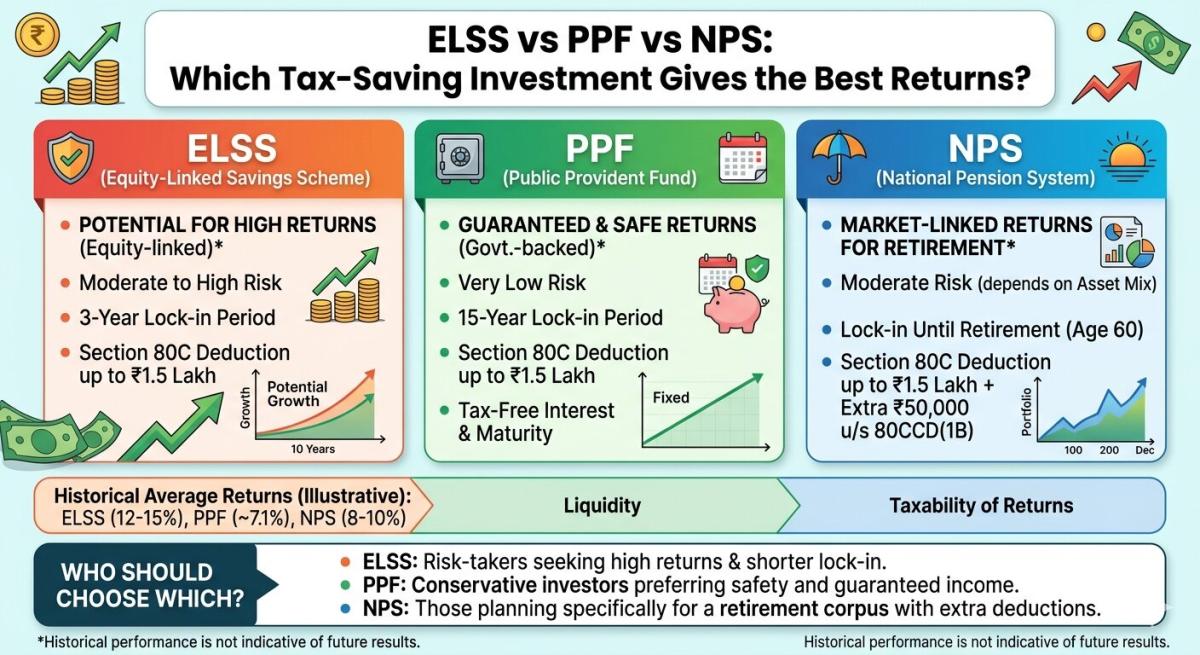
ELSS vs PPF vs NPS: Which Tax-Saving Investment Gives the Best Returns?
Compare ELSS vs PPF vs NPS to find the best tax-saving investment. Understand returns, lock-in periods, and features to choose what suits your goals.
Arjun Sharma
Content Lead – Banking & Payments

Published on Mar 26, 2026
How to Start SIP with ₹500 Per Month: Beginner's Guide to Mutual Funds
Learn how to start a SIP with ₹500 per month in mutual funds. Simple beginner’s guide to investing, building wealth, and growing money with small steps.
Arjun Sharma
Content Lead – Banking & Payments

Published on Mar 02, 2026
What is a Lumpsum Calculator and How Does It Work? Benefits, Accuracy & Planning Tips
Learn how a Lumpsum Calculator works, how it estimates one-time investment returns, and how to use it for smarter financial planning.
Priya Nair
Senior Compliance Editor at IFSC.co
Published on Mar 02, 2026
Mutual Fund Returns Calculator: How It Works, Accuracy & FAQs Explained
A Mutual Fund Returns Calculator helps you estimate the future value of your mutual fund investment using inputs like investment amount, tenure, contributions, and expected returns. It uses compounding to project potential growth and helps you plan smarter investment decisions.
Priya Nair
Senior Compliance Editor at IFSC.co

Published on Apr 10, 2025
Financial Planning: Using SIP Calculators Effectively
Confused about future finances? Learning how to use SIP Calculators can help you reach your goals! Invest small, grow big.
Priya Nair
Senior Compliance Editor at IFSC.co
calculate Financial Calculators
EMI Calculator
FD Calculator
GST Calculator
Lumpsum Calculator
Mutual Fund Returns Calculator
PPF Calculator
RD Calculator
SIP Calculator
SWP Calculator
article Latest Blog Posts
ELSS vs PPF vs NPS: Which Tax-Saving Investment Gives the Best Returns?
Compare ELSS vs PPF vs NPS to find the best tax-saving investment. Understand returns, lock-in periods, and features to choose what suits your goals.
SIP & Investing • 11 MINS READ
How to Start SIP with ₹500 Per Month: Beginner's Guide to Mutual Funds
Learn how to start a SIP with ₹500 per month in mutual funds. Simple beginner’s guide to investing, building wealth, and growing money with small steps.
SIP & Investing • 13 MINS READ
Senior Citizen FD Rates 2026: Which Banks Offer the Highest Interest?
Compare senior citizen FD rates in 2026 and find which banks offer the highest interest. Learn about returns, tenures, and tips to choose the best FD.
FD, PPF & Savings • 12 MINS READ
Sukanya Samriddhi Yojana (SSY): Interest Rate, Rules & Calculator Guide 2026
Learn about Sukanya Samriddhi Yojana (SSY) including eligibility criteria, required documentation, step by step application process, tax benefits explanation and comparison b/w SSY, PPF and FD
FD, PPF & Savings • 11 MINS READ
2 reasons why online banking is important in today’s COVID-19 situation
Discover why online banking became essential during COVID-19. Learn how digital banking ensured safety, convenience, and uninterrupted financial services.
Digital Banking • 4 MINS READ