A Comprehensive Guide to Home Loan Interest Rates: Fixed vs. Floating in 2026
A detailed 2026 guide to home loan interest rates comparing fixed, floating, and hybrid options. Learn the real cost difference, EMI impact, risks, RBI policies, and which option saves you more over 20 years.
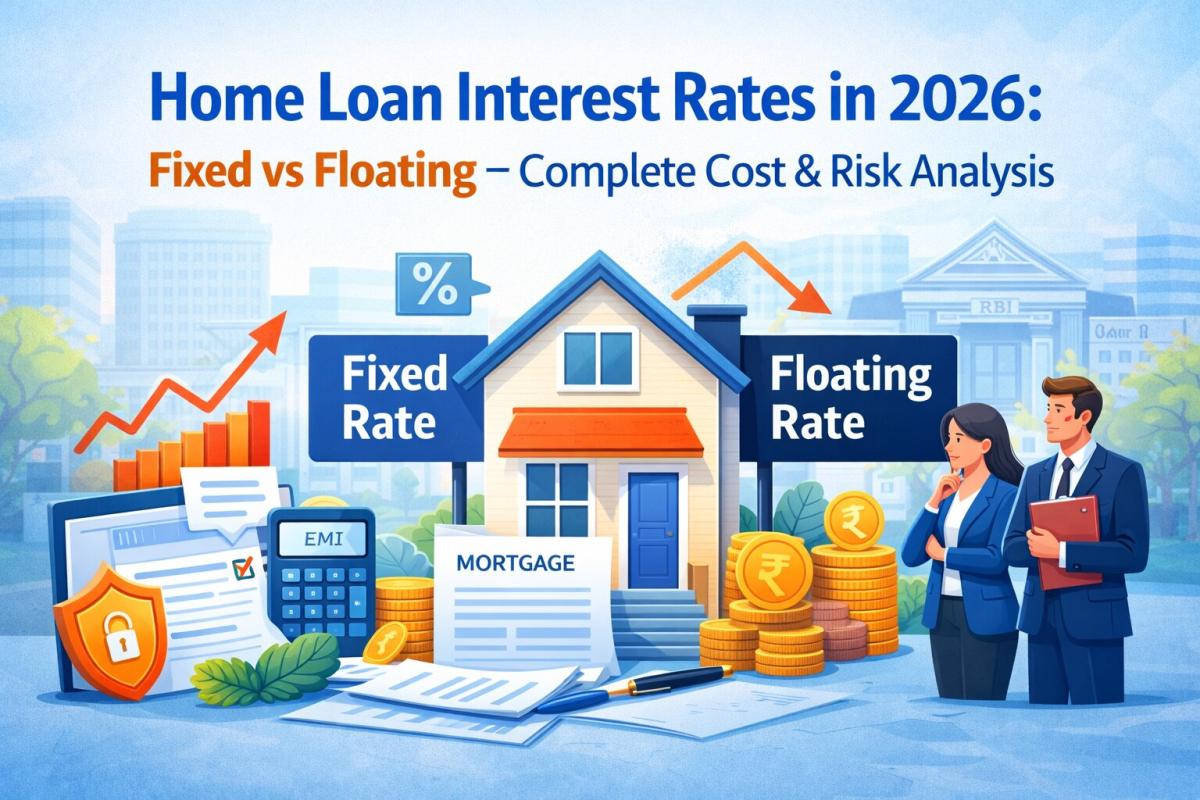
Table of Contents
If you are applying for a home loan in 2026, you are entering a market that looks vastly different from the volatile days of 2023-2024. With the Reserve Bank of India (RBI) maintaining the Repo Rate at a steady 5.25% this January, the chaos of quarterly rate hikes has largely subsided.
However, stability brings its own confusion. Banks are now aggressively marketing "Hybrid" and "Fixed Rate" products to lock you in before the next potential rate cut cycle. You might be asking: "Should I lock in my rate now to stay safe, or ride the floating wave to save money?"
The answer isn't just about the number on the brochure; it is about the "Real Cost" of the loan over 20 years. In 2026, the gap between Fixed and Floating rates has widened to almost 2.5%, creating a massive penalty for those seeking "peace of mind."
Here is your definitive, deep-dive guide to navigating the Fixed vs. Floating debate in the current economic climate.
The 2026 Snapshot: Floating vs. Fixed
Let’s stop guessing and look at the raw numbers. I have analyzed the current offers from top lenders (SBI, HDFC Bank, ICICI) as of January 2026.
|
Feature |
Floating Rate (Repo Linked) |
Genuine Fixed Rate |
Hybrid / Semi-Fixed |
|
Current Rate (2026) |
7.50% – 8.70% |
9.90% – 11.50% |
8.95% (Fixed for 3 yrs) |
|
Benchmark |
Linked to RBI Repo Rate (EBLR). |
Bank’s internal cost of funds. |
Mixed. |
|
Prepayment Penalty |
ZERO (Mandated by RBI). |
2% – 4% of principal prepaid. |
Zero during floating period only. |
|
Risk Factor |
Rate Risk: EMIs rise if RBI hikes rates. |
Opportunity Risk: You pay more if market rates fall. |
Reset Risk: Auto-converts to high floating rates later. |
|
Best For... |
95% of borrowers (Salaried/Self-employed). |
Borrowers with strict cash flow who cannot tolerate ANY hike. |
Short-term investors planning to sell in 3-5 years. |
Deep Dive: Analyzing Your Options
1. Floating Rate (Repo Linked): The "Smart" Choice
In 2026, all new floating rate loans are mandatorily linked to an External Benchmark, usually the Repo Rate.
- The Mechanism: Your rate = Repo Rate (5.25%) + Bank’s Spread (2.25% - 3.00%).
- The 2026 Context: With inflation stabilized around 4.5%, the RBI is unlikely to hike rates aggressively this year. Most economists predict a "pause" or a shallow cut of 25 basis points by late 2026. If you choose a floating rate of 8.50% today, and the RBI cuts rates, your interest burden drops automatically within the next quarter.
- The Pro: Zero Prepayment Charges. This is the killer feature. You can dump your annual bonus into the loan to slash your principal without paying a penny in penalties.
- The Con: Unpredictability. If a geopolitical crisis hits in 2027 and inflation spikes, the RBI could hike rates, increasing your tenure or EMI.
2. Fixed Rate: The "Expensive" Safety Net
True "Fixed Rate" loans are rare in India. Most banks offer them at a massive premium.
- The Mechanism: The bank takes the interest rate risk on your behalf. To cover this risk, they charge you a premium of 200-300 basis points above the floating rate.
- The Trap: Many loans marketed as "Fixed" are actually "Reset Fixed" loans. The rate is fixed only for 3 to 5 years, after which the bank has the right to reset it to the prevailing market rate. You pay a premium for safety that isn't even permanent.
- The Penalty: Unlike floating loans, RBI allows banks to charge prepayment penalties on fixed loans. If you want to close your loan early, be ready to pay 2-4% of the outstanding amount as a fine.
3. Hybrid Loans: The "Teaser" Trap
These products offer a fixed rate for the first 2-3 years, followed by a floating rate.
- Why avoid it: In 2026, the fixed period rate (approx 9.00%) is still higher than the current floating rate (7.50%). You are paying extra now to avoid a theoretical risk in the future. It rarely makes mathematical sense unless you expect rates to skyrocket immediately.
Senior Editor’s Verdict: The "Spread" Strategy
In 2026, the mathematical verdict is clear.
"My Advice: Stick to Floating Rates. The 'Insurance Premium' on Fixed Rates is too high."
Why? Because the spread between Floating (8.50%) and Fixed (10.50%) is 2%.
For the Fixed Rate to "win," the RBI would need to hike the Repo Rate by 200 basis points (from 5.25% to 7.25%) within the next year. Given the current controlled inflation data, such a drastic hike is highly improbable.
Who should actually take a Fixed Rate?
Only one type of borrower: Someone with a rigid, non-negotiable monthly budget who would default if their EMI increased by even ₹2,000. If you are living paycheck to paycheck with zero buffer, the peace of mind of a Fixed Rate might be worth the extra cost. For everyone else, Floating is the winner.
The Math: The Cost of "Safety"
Let’s quantify the difference.
Loan Scenario: ₹50 Lakhs for 20 Years.
- Option A: Floating Rate @ 8.50%
- EMI: ₹43,391
- Total Interest Payable: ₹54.13 Lakhs
- Total Payment: ₹1.04 Crores
- Option B: Fixed Rate @ 10.50%
- EMI: ₹49,919
- Total Interest Payable: ₹69.80 Lakhs
- Total Payment: ₹1.19 Crores
The Difference:
By choosing Fixed, you pay ₹6,528 extra per month.
Over the life of the loan, you pay ₹15.67 Lakhs EXTRA in interest.
Ask yourself: Is "peace of mind" worth ₹15 Lakhs?
Security & Risks: What You Need to Know
When discussing "Security" in home loans, we aren't talking about DICGC (which insures deposits, not loans). We are talking about Regulatory Protection.
- The "Negative Amortization" Risk:
In a floating rate loan, if rates rise, banks prefer to increase your Tenure rather than your EMI. Sometimes, the tenure increases so much that you end up paying only interest for years, and your principal doesn't decrease.
-
- 2026 Regulatory Alert: The RBI now mandates that banks must give you a choice to switch to a Fixed Rate or increase EMI whenever the rate resets. They cannot infinitely extend your tenure without consent.
- Asset Seizure (SARFAESI Act):
Your home is the collateral. If you default on EMIs for 90 days, the loan becomes an NPA (Non-Performing Asset). Under the SARFAESI Act, the bank can initiate auction proceedings without court intervention.
-
- Safeguard: Always maintain an "Emergency Fund" equal to 6 months of EMIs in a separate High-Yield Savings Account.
- Foreclosure Charges:
Be aware that while individual borrowers pay zero foreclosure charges on floating loans, "Non-Individual" borrowers (e.g., if you take the loan in your Company or LLP's name) can still be charged penalties.
Actionable Checklist: Getting the Best Rate in 2026
- Check the "Spread": The Repo Rate (5.25%) is the same for everyone. The difference is the "Spread" the bank charges you. A spread of 2.00% - 2.25% is excellent. Anything above 3.00% is expensive.
- Boost Your CIBIL: In 2026, banks use "Risk-Based Pricing." A CIBIL score of 780+ can get you a rate of 8.35%, while a score of 720 might get you 8.85%. That 0.5% difference saves you lakhs.
- Negotiate "Conversion Fees": If you are an existing borrower stuck on an old rate (e.g., 9.5%), ask your bank to switch you to the new lower rate. They will charge a "Conversion Fee" (usually ₹2,000 - ₹5,000). Pay it. The savings in EMI will recover this cost in 2 months.
- Maxgain / Overdraft Options: If you are self-employed, consider an "Overdraft Home Loan" (like SBI Maxgain). You can park your surplus business cash in the loan account to save interest, and withdraw it when you need liquidity.
Frequently Asked Questions (FAQ)
1. Can I switch from Floating to Fixed later if rates start rising?
Yes, most banks allow this. However, they will charge a "Conversion Fee," and the new Fixed Rate offered will likely be much higher than your existing Floating Rate. It’s rarely a beneficial move during a hiking cycle.
2. Is there any tax benefit difference between Fixed and Floating?
No. Under Section 24(b) (Interest deduction up to ₹2 Lakhs) and Section 80C (Principal repayment), the tax benefits are identical regardless of the interest rate type.
3. Why is my bank offering me a lower rate for the first 2 years?
This is a "Teaser Rate" (Hybrid Loan). Be very careful. Check what the rate becomes after the 2 years. Often, it resets to a rate much higher than the standard floating rate. Always calculate the cost for the full tenure, not just the first 2 years.
4. Does DICGC insurance cover my Home Loan?
No. DICGC insures deposits (savings, FDs) up to ₹5 Lakhs if a bank fails. It does not cover loans. If your bank fails, your loan is simply transferred to the acquiring bank; you still have to repay it.
5. I am planning to prepay my loan in 5 years. Which rate is better?
Floating Rate. Since you plan to prepay, you need a loan with Zero Prepayment Penalties. A Fixed Rate loan would slap you with a 2-4% penalty on the prepaid amount, destroying your savings.
Related Blogs
Published on May 24, 2025
Understanding How to Calculate EMI Accurately
Whether personal or home, loans offer everyone easy access to cash to complete their dreams and needs. Understand how to calculate EMI easily and accurately.

Priya Nair
Senior Compliance Editor at IFSC.co

Published on May 18, 2025
Tips on How to Calculate Monthly EMI for Any Loan
Struggling to understand your EMI amount? This blog covers all the necessary tips on how to calculate your monthly EMI to help you stay ahead of your finances.
Priya Nair
Senior Compliance Editor at IFSC.co
Published on May 10, 2025
Personal EMI Calculators: What You Need to Know
Personal loans come in handy for meeting the urgent needs of the time but with higher interest rates. This necessitates using a personal loan EMI calculator.
Priya Nair
Senior Compliance Editor at IFSC.co
Published on Apr 25, 2025
Monthly EMI Calculators: A Detailed Overview
Monthly EMI calculators allow you to get a pre-hand idea of the EMI you must pay monthly. In return, an EMI calculator per month helps manage monthly finances better.
Priya Nair
Senior Compliance Editor at IFSC.co

Published on Mar 02, 2025
Buying a Car? Here's How to Use a Vehicle EMI Calculator the Smart Way
Plan your car or bike loan with ease. Learn how to use a vehicle EMI calculator, input values correctly, and get accurate monthly EMI instantly.
Priya Nair
Senior Compliance Editor at IFSC.co
article Latest Blog Posts
A Comprehensive Guide to Home Loan Interest Rates: Fixed vs. Floating in 2026
A detailed 2026 guide to home loan interest rates comparing fixed, floating, and hybrid options. Learn the real cost difference, EMI impact, risks, RBI policies, and which option saves you more over 20 years.
EMI & Loans • 8 MINS READ
Mutual Fund Returns Calculator: How It Works, Accuracy & FAQs Explained
A Mutual Fund Returns Calculator helps you estimate the future value of your mutual fund investment using inputs like investment amount, tenure, contributions, and expected returns. It uses compounding to project potential growth and helps you plan smarter investment decisions.
SIP & Investing • 6 MINS READ
Planning an FD? Don’t Miss These Top Questions About FD Calculators
Curious how FD calculators work? This guide answers the top questions to help you calculate returns, compare plans, and invest smarter in fixed deposits.
FD, PPF & Savings • 5 MINS READ
PPF (Public Provident Fund) Calculator – Returns, Interest & Planning Guide
A PPF Calculator helps you estimate the maturity value and interest earned on your Public Provident Fund investment. By entering your contribution amount, tenure, and current interest rate, you can project long-term returns and plan your savings effectively.
FD, PPF & Savings • 6 MINS READ
Recurring Deposit (RD) Calculator – Returns, Interest & Maturity Guide
An RD Calculator helps you estimate the maturity amount and interest earned on your Recurring Deposit investment. By entering your monthly deposit, tenure, and interest rate, you can project returns and plan your savings effectively.
FD, PPF & Savings • 5 MINS READ