Recurring Deposit (RD) Calculator – Returns, Interest & Maturity Guide
An RD Calculator helps you estimate the maturity amount and interest earned on your Recurring Deposit investment. By entering your monthly deposit, tenure, and interest rate, you can project returns and plan your savings effectively.
Table of Contents
- 1. What is an RD Calculator, and how does it work?
- 2. How can an RD Calculator help me plan my investments in Recurring Deposits?
- 3. What factors does an RD Calculator consider when calculating returns?
- 4. Can an RD Calculator predict future investment performance accurately?
- 5. Is an RD Calculator suitable for all types of investors?
- 6. Are the results from an RD Calculator guaranteed?
- 7. How frequently should I use an RD Calculator to track my investments?
- 8. Can an RD Calculator help me compare different Recurring Deposit schemes?
- 9. Are there any fees associated with using an RD Calculator?
- 10. How reliable are the projections provided by an RD Calculator?
1. What is an RD Calculator, and how does it work?
The RD (Recurring Deposit) Calculator is a financial tool against which one can estimate the future value of recurring deposit investments. The calculator will show your maturity amount if you enter these details, like the monthly deposit amount, interest rate, and tenure of the deposit.
It uses the concept of compound interest formula with periodic additions and frequency of compounding included, which is normally quarterly. This tool will make it easy on the part of the investor to learn how the expected return from his regular deposits will grow, thereby helping in proper financial planning.
2. How can an RD Calculator help me plan my investments in Recurring Deposits?
The accurate RD Calculator helps you schedule your investments efficiently by clearly projecting what your returns from recurring deposits will be. It shows you how your regular contributions would grow with time for different amounts, tenures, and interest rates that you key in.
This helps in setting realistic financial goals, understanding various impacts on the final maturity amount, and comparing various RD schemes to choose the best, which serves the financial objectives better.
3. What factors does an RD Calculator consider when calculating returns?
An RD Calculator takes into consideration a few basic factors to calculate returns:
- Monthly Deposit Amount: It refers to the fixed amount that you agree to deposit every month.
- Interest Rate: This is an annual interest rate that the bank will offer you.
- Tenure: A recurring deposit would be usually payable from a minimum period of six months to a maximum period of a number of years.
- Compounding Frequency: This is how frequently the bank will compound the interest, usually quarterly.
The RD calculator will factor in these inputs to arrive at the correct total interest that would be earned and the maturity amount. This will also give you a very clear picture of the growth that your recurring deposits can potentially rocket up to.
4. Can an RD Calculator predict future investment performance accurately?
An RD Calculator undoubtedly projects the performance of a future investment quite accurately since recurring deposits guarantee a certain rate of return. The interest rate on recurring deposits is not subject to change with market conditions like market-linked investments. Nevertheless, how accurate those predictions are depends on the accuracy of the input data.
The calculator can give accurate estimates, and the actual return could differ slightly over a period of time due to changes in the frequency of compounding or on account of early withdrawals.
5. Is an RD Calculator suitable for all types of investors?
An RD Calculator is good for all types of investors, whether risk-averse or looking for a safe investment avenue. A recurring deposit is good for investors who have low-risk profiles and seek predictable returns from the habit of regular savings. The calculator helps first-time and experienced investors alike understand potential returns from their monthly investments.
6. Are the results from an RD Calculator guaranteed?
Yes, results from an RD Calculator are typically guaranteed, subject to the condition that the inputs entered are correct and the RD terms are taken to their complete term. A recurring deposit carries a fixed interest rate throughout its tenure. That is what makes the returns quite predictable.
The calculator rightly portrays this by stating that the maturity amount is what would result from the indicated interest rate and tenure. However, any changes in the deposit stipulations or premature withdrawals change the actual returns. As long as the RD terms are maintained, the projection by the calculator can be considered trustworthy enough.
7. How frequently should I use an RD Calculator to track my investments?
You can periodically check the growth of your investment by using an RD Calculator after opening a new recurring deposit or in case the interest rates have changed. While the returns from an RD are utterly predictable, you can update them when you are planning new deposits or comparing schemes to be certain of getting the most out of your savings strategy.
Regular use of it will keep you alert about the progress, adjust contributions if needed, and make you certain of making the right decision regarding your goal.
8. Can an RD Calculator help me compare different Recurring Deposit schemes?
Yes, an RD Calculator is incredibly user-friendly and efficient in comparing various recurring deposit schemes. You simply enter the same monthly deposit amount, tenure, and interest rates, which differ for different RDs, to find out the projected maturity amounts.
This comparison allows you to identify the most beneficial schemes, considering compounding frequency and special rates for senior citizens, among other variables. It helps you make an informed decision about the right RD scheme best suited to achieve your financial goal.
9. Are there any fees associated with using an RD Calculator?
Most of the time, there are no charges for using an RD Calculator. Banks, other financial institutions, or financial planning websites offer these as free tools to help people make sound investment decisions. They are easy to use and can be logged into right from your workplace or home. However, it is always advisable to check that you are using a reputable source for getting full and reliable information at no extra cost.
10. How reliable are the projections provided by an RD Calculator?
The projections of an RD Calculator are highly accurate because recurring deposits bear a fixed return over the defined tenure. It uses accurate mathematical formulae to derive the interest amount and the maturity amount if the inputs are accurately provided.
As RDs do not depend on market fluctuations, the estimates are consistent and reliable. However, small differences in terms of deposits or premature withdrawals slightly change the real returns. Otherwise, it gives reliable estimates for planning purposes.
Related Blogs

Published on Mar 27, 2026
Senior Citizen FD Rates 2026: Which Banks Offer the Highest Interest?
Compare senior citizen FD rates in 2026 and find which banks offer the highest interest. Learn about returns, tenures, and tips to choose the best FD.
Arjun Sharma
Content Lead – Banking & Payments
Published on Mar 27, 2026
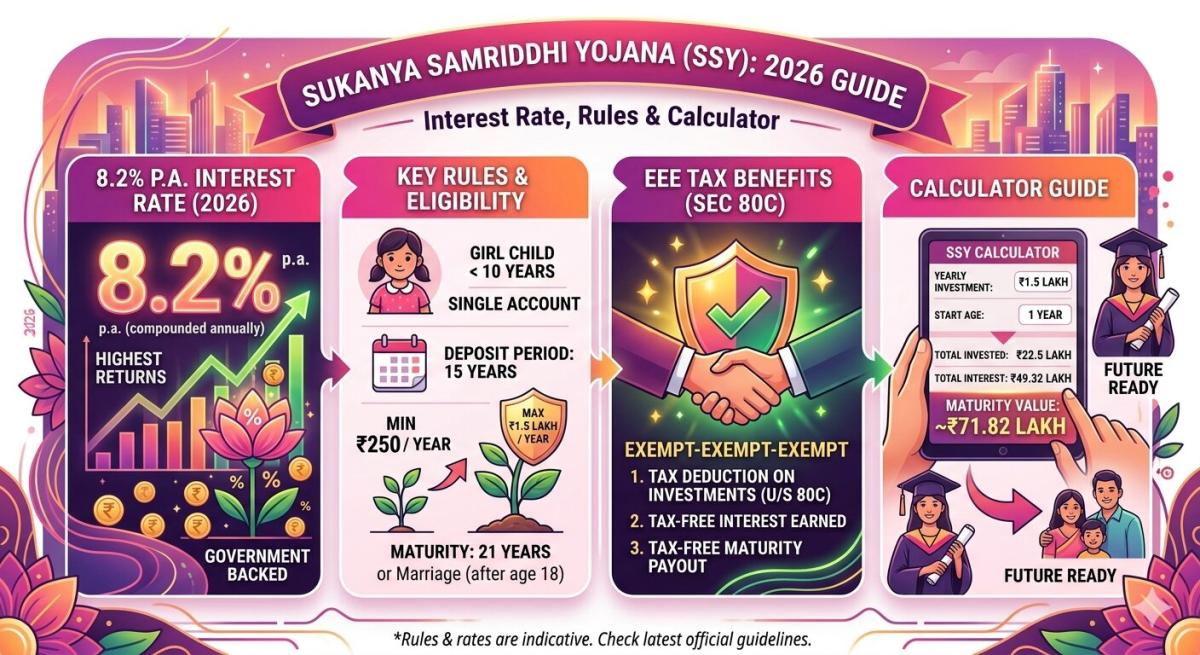
Sukanya Samriddhi Yojana (SSY): Interest Rate, Rules & Calculator Guide 2026
Learn about Sukanya Samriddhi Yojana (SSY) including eligibility criteria, required documentation, step by step application process, tax benefits explanation and comparison b/w SSY, PPF and FD
Arjun Sharma
Content Lead – Banking & Payments
Published on Mar 02, 2026
Planning an FD? Don’t Miss These Top Questions About FD Calculators
Curious how FD calculators work? This guide answers the top questions to help you calculate returns, compare plans, and invest smarter in fixed deposits.
Priya Nair
Senior Compliance Editor at IFSC.co

Published on Mar 02, 2026
PPF (Public Provident Fund) Calculator – Returns, Interest & Planning Guide
A PPF Calculator helps you estimate the maturity value and interest earned on your Public Provident Fund investment. By entering your contribution amount, tenure, and current interest rate, you can project long-term returns and plan your savings effectively.
Priya Nair
Senior Compliance Editor at IFSC.co
Published on Jun 02, 2025
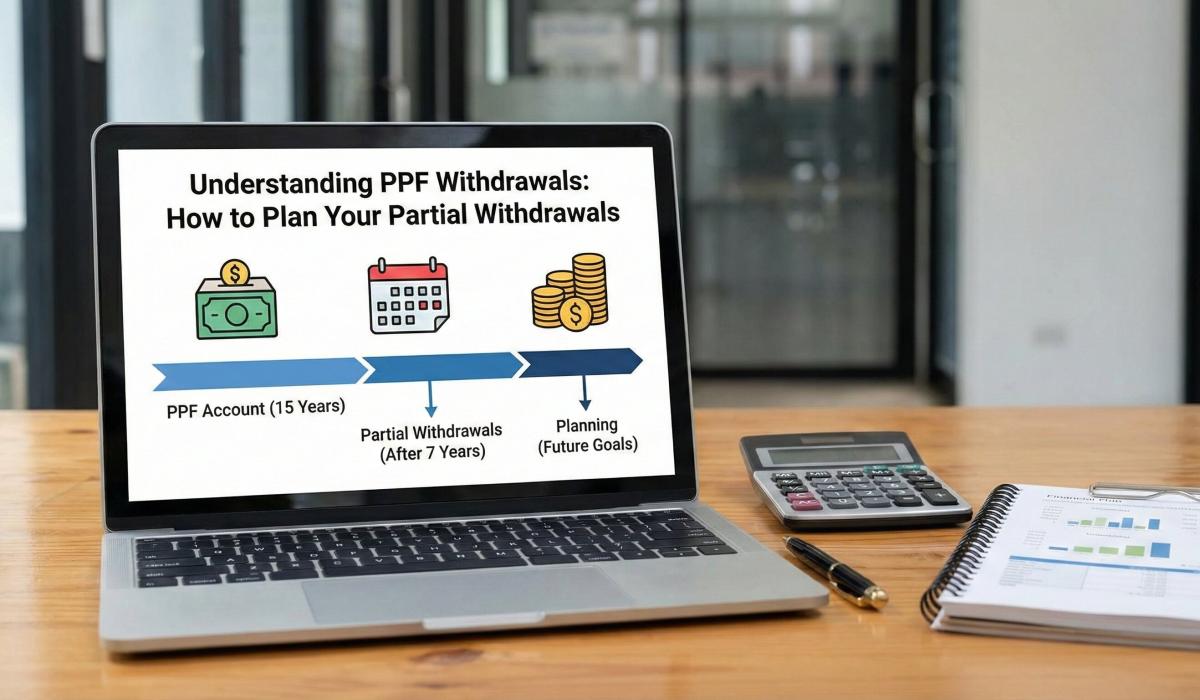
Understanding PPF Withdrawals: How to Plan Your Partial Withdrawals
Learn the rules and strategies for partial PPF withdrawals to meet financial goals without compromising long-term savings.
Priya Nair
Senior Compliance Editor at IFSC.co
calculate Financial Calculators
EMI Calculator
FD Calculator
GST Calculator
Lumpsum Calculator
Mutual Fund Returns Calculator
PPF Calculator
RD Calculator
SIP Calculator
SWP Calculator
article Latest Blog Posts
ELSS vs PPF vs NPS: Which Tax-Saving Investment Gives the Best Returns?
Compare ELSS vs PPF vs NPS to find the best tax-saving investment. Understand returns, lock-in periods, and features to choose what suits your goals.
SIP & Investing • 11 MINS READ
How to Start SIP with ₹500 Per Month: Beginner's Guide to Mutual Funds
Learn how to start a SIP with ₹500 per month in mutual funds. Simple beginner’s guide to investing, building wealth, and growing money with small steps.
SIP & Investing • 13 MINS READ
Senior Citizen FD Rates 2026: Which Banks Offer the Highest Interest?
Compare senior citizen FD rates in 2026 and find which banks offer the highest interest. Learn about returns, tenures, and tips to choose the best FD.
FD, PPF & Savings • 12 MINS READ
Sukanya Samriddhi Yojana (SSY): Interest Rate, Rules & Calculator Guide 2026
Learn about Sukanya Samriddhi Yojana (SSY) including eligibility criteria, required documentation, step by step application process, tax benefits explanation and comparison b/w SSY, PPF and FD
FD, PPF & Savings • 11 MINS READ
2 reasons why online banking is important in today’s COVID-19 situation
Discover why online banking became essential during COVID-19. Learn how digital banking ensured safety, convenience, and uninterrupted financial services.
Digital Banking • 4 MINS READ