How to Start SIP with ₹500 Per Month: Beginner's Guide to Mutual Funds
Learn how to start a SIP with ₹500 per month in mutual funds. Simple beginner’s guide to investing, building wealth, and growing money with small steps.

Arjun Sharma
Content Lead – Banking & Payments
13 min read
Table of Contents
Everybody wants to grow their money and accumulate wealth. However, most people believe that investing requires a lot of money. Well, this is not true, and you don't need thousands of rupees to invest and grow your money. You can start investing with as little as ₹500 every month through a Systematic Investment Plan, also known as a SIP, in a mutual fund. This is the amount we spend on small things every week. You do not have to start with much to become rich, but you must start early and be consistent with your savings. This guide will show you how you can start an SIP with just ₹500 and grow your money.
What Is a SIP?
A SIP is a smart way to invest your money in a disciplined way. A SIP is like a subscription to a service or a plan, but in this case, it is a subscription to your own personal plan. Suppose you start a SIP of ₹500 every month, then every month, ₹500 will be invested in your mutual fund scheme. You do not need to remember to invest every month; it will be done automatically for you.
What Are Mutual Funds?
Mutual Funds are a collection of funds that pool money from multiple investors. Once the money is pooled, it is then invested in different funds by experts, also known as fund managers. These experts invest money in different things, like:
- Stocks of Companies
- Government Bonds
- Debt of Companies
- Other Financial Instruments
So, instead of you worrying about which stock to buy and when, a professional does all the work for you. This is highly beneficial for you if you are a beginner and have little knowledge of the stock market.
Why Starting with ₹500 is Actually a Great Idea?
You might think that starting with ₹500 is not a big deal. You might even think, "What is the point of investing such a small amount?" This is a very valid question. Well, to answer your question, ₹500 is one of the best ways to start investing in Mutual Funds through a SIP. Here are some reasons why starting with Rs. 500 is a great idea:
Removes Fear
Starting small removes our biggest fear: fear itself. If we are given the chance to invest a large sum, we are scared. We are scared of losing our hard-earned money and making mistakes. But when we start small, our biggest fear is removed. We do not feel as if we are risking much. It feels safe, and that's why we are more likely to take the first step and start investing.
Starting small helps us get into a habit. We are aware that investing is not about doing something big and then stopping. It is about doing something small consistently. And starting small in this way helps us get into that habit. If you are unsure about the potential returns, you can always use a SIP calculator to get an idea and then start planning better.
Gives You Time to Learn
If you invest just ₹500, you'll have time to learn the market and see how mutual funds work. You'll also have time to see your money grow. Learning by doing is much better than reading or watching videos.
Makes Investing Easier
You don't have to worry if the market goes down. You have invested very little. You also have time to see the market go up and down. You start to understand that it's normal for the market to go up and down. This is very important.
You Can Grow the Amount Anytime
You can start with ₹500. Tomorrow, you can start with ₹1,000 or even more. Most successful investors didn't start with a lot. They started small and then went up.
So, don't wait for more money to come. Start investing now. ₹500 is as good as it gets. It's not small. It's good enough to start.
How Does SIP Actually Work?
When you start investing through SIP, your ₹500 is invested in Mutual Funds. The price at which you buy a Mutual Fund is called Net Asset Value.
And now, here's something important.
The markets fluctuate. So,
- When the markets fall, your ₹500 can either buy more Mutual Funds.
- When the markets rise, your ₹500 can either buy fewer Mutual Funds.
That's rupee cost averaging. And in this way, you get to learn about the markets too.
So, instead of thinking about when to invest, you just invest.
What Is Compounding and Why Is It Important?
Compounding is also known as the eighth wonder of the world. And that's exactly what it is.
It's when your returns start generating returns of their own.
Let's take an example. Let's say you invest ₹500 every month via a SIP.
At first, your investment may not grow much. But later on, your returns are added to your investment. And those returns start generating returns of their own, too.
So, in a way, this is a snowball effect too. The more you invest, the more your investment grows. And that's exactly why it's always recommended to start investing at a young age, even if you invest a small amount.
Types of Mutual Funds and How to Choose the Right One?
It may not be easy at first to choose the right Mutual Funds for your investment needs, as there are many options to consider. However, once you get a basic idea about the different types of Mutual Funds and their characteristics, it is not a difficult task at all.
If you need an idea about the potential growth of your investment in the future, a Mutual Fund calculator may help you with the same.
So, let's get into the details and try to understand the different types of Mutual Funds and the right choice for your investment needs.
1. Equity Funds (For Long-Term Growth)
Equity funds are those mutual funds that invest your money in the stock market. So, your money is directly related to the stock market and, hence, the stock prices. This simply means that equity funds may provide higher returns in the future for your investment. So, if you keep your money invested for a longer period, it is sure to grow and provide higher returns.
However, it may be volatile in the short term and continue to fluctuate frequently.
If you can keep your cool during such times, equity funds may be a good choice for your investment needs. For beginners, it is recommended that they start with large-cap equity funds. Large-cap equity funds invest in large and stable companies.
2. Debt Funds (For Stability and Safety)
Debt funds invest your money in bonds and fixed-income securities. These types of mutual funds are much safer compared to equity mutual funds. So, if you need to keep your money safe and secure while earning a return, debt mutual funds may be a good choice for your investment needs.
However, it is important to note that returns may not be higher than those of equity mutual funds.
When to invest in debt funds:
- You want low risk.
- You want to invest for the short term.
- You want stability over high returns.
3. Hybrid Funds (Best of Both Worlds)
Hybrid mutual funds are a mix of equity and debt mutual fund investments.
This type of mutual fund investment is considered much safer than an equity mutual fund investment. This type of investment is considered to be the best option for a beginner to start investing in mutual funds.
How to Choose the Right One?
If you are a beginner looking to start your mutual fund investment through a Systematic Investment Plan, then it is important to remember that you don't need to overcomplicate things. You need to answer a few questions. You need to ask yourself:
- Do you have 5 years or more to invest? → Equity or Hybrid Funds
- Do you want to play it safe and want stability? → Debt Funds
- Do you want to start with a safe option and later move to other types of mutual fund investments? → Hybrid Funds
It is important to remember that there is no such thing as the 'perfect' mutual fund. The 'perfect' mutual fund is the one that makes you comfortable and encourages you to continue investing.
Step-by-Step: How to Start SIP with ₹500
Here is exactly what you need to do to start investing your money in SIPs.
Step 1: Decide Your Goal
Before you invest, ask yourself one simple question: Why am I investing?
It could be:
- Buying a bike
- Saving for future needs
- Building an emergency fund
- Wealth creation
Having a goal in mind makes you more likely to stick to your plan.
Step 2: Choose The Right Fund
Choose a mutual fund scheme based on your risk tolerance. If you are unsure, you may start with a hybrid or a large-cap equity fund. Do not aim for the highest returns. Aim for consistent performance.
Step 3: Complete Your KYC
You are not allowed to start your investments unless you complete your KYC. It is a simple process, and you can complete your KYC online.
You need to provide:
- PAN Card
- Aadhaar Card
- Bank details
Once you have completed your KYC, you are ready to start investing.
Step 4: Set Your SIP Amount
You can start your SIP with as low as Rs. 500. Do not overthink. Just start.
Step 5: Choose A Date
Choose a date when you are sure you have enough in your account. This way, your SIP will not fail.
Step 6: Activate Auto Debit
Auto debit facility enables your SIP to be invested automatically. You do not have to remember to invest. Your SIP investments are done automatically.
Tips for Investing in Mutual Funds
Even if you have made up your mind to start your investments in mutual funds, there are always ways to improve and make the most out of your investments. So, here are some tips that will help you:
Stay Invested, Especially When Markets Fall
Even though this may seem to be quite controversial, when the market is falling, it is one of the best times to be an investor. This is because you will be able to buy more mutual fund units at a lower price. Many investors fear that when the market is falling, but remember that the market will always rise in the future.
Increase Your SIP Slowly Over Time
The worst thing you can do as an investor is stop increasing your investment. For instance, even when you have started investing ₹500, you should always try to increase your investment as your income increases. This will enable you to earn more from your investment. You don't have to increase your investment too much; you can increase it by even ₹100 or ₹200.
Keep It Simple
You don't need to invest in many mutual funds. At the initial stage, even one or two mutual funds are enough. Too many mutual funds will make things complicated and confusing.
Avoid Checking Your Investments Too Often
It is quite tempting to check your investment's value every day, especially when you are new to it. However, remember that too much checking will cause you stress. The stock market is constantly changing; hence, it is advisable to check your investment once every few months or even once every year. You need to be patient and focus on the long term.
Stay Patient and Trust the Process
We live in a world where we want things to happen quickly. We want everything to happen today. But investing is not like that. A SIP in Mutual Funds is best when you allow it to work. There will be periods when you feel that your investment is growing too slowly. But that is normal. You need to be patient, and slowly and steadily, you will start to see the real magic of investing.
Where Can You Start SIP?
You can start your SIP through:
- Bank websites
- Investment apps
- Official mutual funds websites
You need to select the one that is easy to use and simple.
Final Thoughts
If you want to grow your wealth but don’t have a lot of money to invest, then there’s no better option than mutual funds. With mutual funds, you can start investing with as little as Rs. 500 per month. Then, all you have to do is be consistent and let compounding do its thing. There are so many mutual fund options you can invest in, but make sure that you choose the right one according to how much risk you can comfortably take, how long you want to stay invested for, and what magnitude of returns you’re expecting. But the most important thing is to just start and not overthink your decision.
FAQs
1. Can I run multiple SIPs of ₹500 in different Mutual Funds?
Yes, you can run as many SIPs as you want and invest in as many Mutual Funds as you want to diversify your portfolio.
2. What happens if my SIP payment fails one month?
If your SIP fails, you’ll be given some time to add the funds yourself again. But if you don’t do it for long, the fund house will auto-terminate your SIP.
3. Can I change my SIP date after starting it?
Yes, you can change your SIP date based on your preferences and requirements. You can even start a completely new SIP date.
4. Is there any penalty for stopping a SIP midway?
No, there is usually no penalty for stopping a SIP. You can stop your SIP at any time without any problems whatsoever.
5. Can I withdraw money anytime from my SIP investment?
Yes, you can withdraw your money anytime you want. But if the funds you’ve invested in have a lock-in period, then you’ll have to pay a penalty if you withdraw your funds before that period.
6. Do I need a Demat account to start SIP?
No, you don’t require a demat account to start an SIP at any mutual fund.
7. What is the minimum duration for a SIP?
There is no fixed minimum duration for a SIP. However, it is better to stay invested for the long term to get good returns and benefit from compounding.
8. Can I increase my SIP amount later?
Yes, you can increase your SIP amount at any time. Many platforms also offer a “step-up SIP” option, where your investment amount increases automatically over time.
Related Blogs
Published on Mar 26, 2026
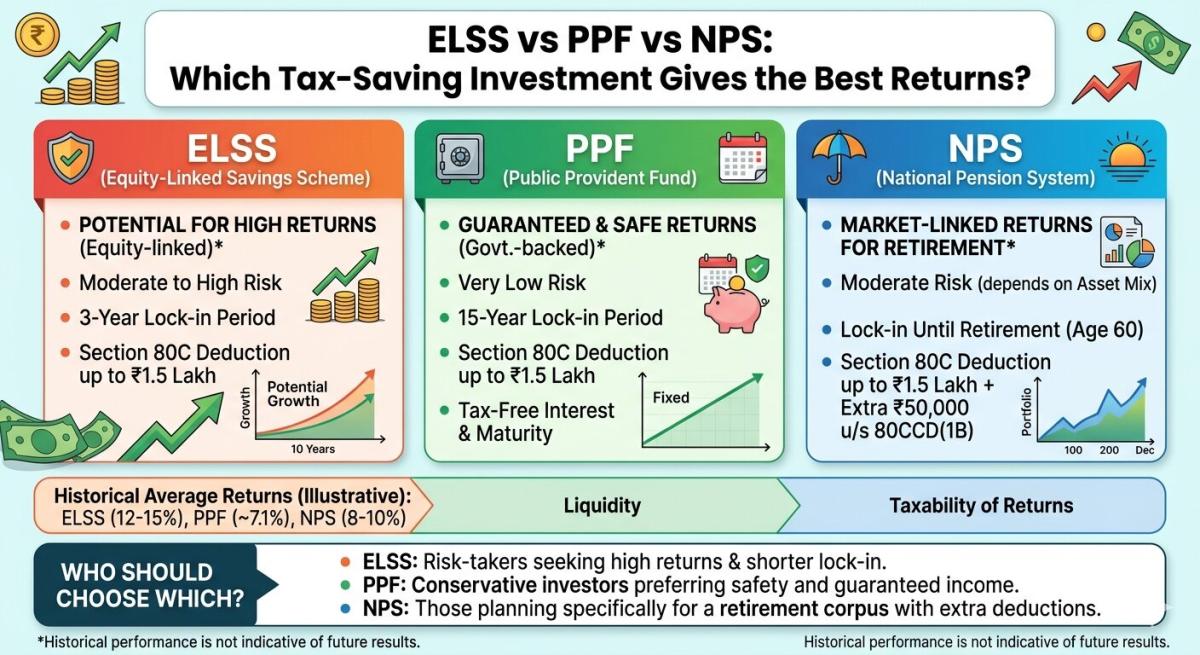
ELSS vs PPF vs NPS: Which Tax-Saving Investment Gives the Best Returns?
Compare ELSS vs PPF vs NPS to find the best tax-saving investment. Understand returns, lock-in periods, and features to choose what suits your goals.
Arjun Sharma
Content Lead – Banking & Payments

Published on Mar 02, 2026
What is a Lumpsum Calculator and How Does It Work? Benefits, Accuracy & Planning Tips
Learn how a Lumpsum Calculator works, how it estimates one-time investment returns, and how to use it for smarter financial planning.
Priya Nair
Senior Compliance Editor at IFSC.co
Published on Mar 02, 2026
Mutual Fund Returns Calculator: How It Works, Accuracy & FAQs Explained
A Mutual Fund Returns Calculator helps you estimate the future value of your mutual fund investment using inputs like investment amount, tenure, contributions, and expected returns. It uses compounding to project potential growth and helps you plan smarter investment decisions.
Priya Nair
Senior Compliance Editor at IFSC.co

Published on Apr 10, 2025
Financial Planning: Using SIP Calculators Effectively
Confused about future finances? Learning how to use SIP Calculators can help you reach your goals! Invest small, grow big.
Priya Nair
Senior Compliance Editor at IFSC.co

Published on Mar 22, 2025
SIP Explained: How SIP is Calculated for Indian Investors
Invest smart in India with SIPs! Learn how SIP is calculated, the benefits, and grow your wealth through cost averaging & compounding
Priya Nair
Senior Compliance Editor at IFSC.co
calculate Financial Calculators
EMI Calculator
FD Calculator
GST Calculator
Lumpsum Calculator
Mutual Fund Returns Calculator
PPF Calculator
RD Calculator
SIP Calculator
SWP Calculator
article Latest Blog Posts
ELSS vs PPF vs NPS: Which Tax-Saving Investment Gives the Best Returns?
Compare ELSS vs PPF vs NPS to find the best tax-saving investment. Understand returns, lock-in periods, and features to choose what suits your goals.
SIP & Investing • 11 MINS READ
How to Start SIP with ₹500 Per Month: Beginner's Guide to Mutual Funds
Learn how to start a SIP with ₹500 per month in mutual funds. Simple beginner’s guide to investing, building wealth, and growing money with small steps.
SIP & Investing • 13 MINS READ
Senior Citizen FD Rates 2026: Which Banks Offer the Highest Interest?
Compare senior citizen FD rates in 2026 and find which banks offer the highest interest. Learn about returns, tenures, and tips to choose the best FD.
FD, PPF & Savings • 12 MINS READ
Sukanya Samriddhi Yojana (SSY): Interest Rate, Rules & Calculator Guide 2026
Learn about Sukanya Samriddhi Yojana (SSY) including eligibility criteria, required documentation, step by step application process, tax benefits explanation and comparison b/w SSY, PPF and FD
FD, PPF & Savings • 11 MINS READ
2 reasons why online banking is important in today’s COVID-19 situation
Discover why online banking became essential during COVID-19. Learn how digital banking ensured safety, convenience, and uninterrupted financial services.
Digital Banking • 4 MINS READ