How to File ITR-1 (Sahaj) Online in 2026: Step-by-Step Guide for Salaried Employees
Learn how to file ITR-1 (Sahaj) online in 2026 with this simple step-by-step guide for salaried employees. Avoid errors, claim deductions, and file easily.
Priya Nair
Senior Compliance Editor at IFSC.co
13 min read
Table of Contents
If you want to stay tax compliant and make sure that your books are in order, you need to file your income tax returns correctly. Generally, people get confused about how to file their income tax returns, especially when doing it for the first time. Once you become familiar with the process of filing an income tax return, you will realise that it is not a difficult task at all.
One of the most common income tax returns is the ITR-1, known as Sahaj. But what is it, and how do you file it? In this guide, we'll discuss everything about the ITR 1, how you can file it, the documents you need, the latest changes, and the mistakes that people must avoid when filing their ITR 1 returns.
What Is ITR 1?
ITR 1 is also known as Sahaj and is the simplest form of an income tax return that an individual with basic sources of income can file. Generally, the ITR 1 income tax return is filed by salaried class people and pensioners with basic and simple sources of income.
ITR 1 is the most appropriate income tax return form if your income is from a salary source, house property, or from any other source, such as a savings account or fixed deposit interest.
The main aim of the ITR 1 income tax return is to help an individual file their income tax return quickly and easily.
Another advantage of using the ITR-1 income tax return is that there is no need for you to disclose your personal information in detail. The form is designed in such a manner that it is easy for you to understand how to file the income tax return correctly.
Who Can File ITR 1?
Before filing the return, it is essential for the taxpayer to understand whether they are eligible to file the ITR-1 return to avoid any complications during the process.
The following are the conditions for filing the ITR-1 form return:
- Your total income is not more than ₹50 lakh.
- You are a resident individual.
- Your income includes:
- Salary/pension
- Income from house property
- Income from other sources, such as interest
- Long-term capital gains not exceeding ₹1.25 lakh without any loss being carried forward
- Income of the spouse or minor child if it falls under the aforementioned category.
Who Cannot File the ITR-1?
Even though the ITR-1 form is a relatively easy return to file, it is not appropriate for all taxpayers to file the return with this form.
You cannot file the return with the ITR-1 form if your income is:
- More than ₹50 lakhs
- If you are a non-resident or RNOR
- If your income is from a business or profession
- If you have more than one house property
- If your capital gains are more than ₹1.25 lakh
- If you are a director in a company
- If you have unlisted equity shares
- If your income is from a foreign source
- If your income is from an agricultural source and the income exceeds ₹5,000
- If your income is from the lottery, gambling, and racehorse
- If your income is from the source of cryptocurrency and virtual digital assets
If any of the conditions provided above are applicable to your case, then this form cannot be filed. In this case, other forms like ITR-2 or ITR-3 can be filed.
Last Date to File ITR-1 in 2026
Filing your income tax returns is important, but filing your income tax returns within the due date is even more important. Failure to file your return within the due date may attract a penalty. The due date to file your return using this form is 31st July 2026.
If you fail to file your return within this due date, then you can file your belated return till 31st December 2026. However, a penalty may be applicable. It is always best to file your return as soon as possible to avoid any technical problems.
Documents Required to File ITR-1
Before filing your return, it is always best to keep all your documents ready. This will help you save time and avoid errors while filing your return. These are the documents required to file your ITR-1 return:
- Form 16 issued by your employer
- Form 26AS to verify your TDS
- PAN card
- Aadhaar card
- Bank account details
- Investment documents
- Interest certificates issued by banks or the post office
It is always better to verify your Form 16 details with your Form 26AS.
Structure of the ITR-1 Form
Understanding the structure of the ITR-1 form can help you file your return easily. The structure is divided into various sections that guide you through each step.
The main sections in the ITR-1 form are as follows:
Part A - General Information
Personal details
Part B - Gross Total Income
Income from all sources
Part C - Deductions & Taxable Income
Details under various sections
Part D - Tax Computation
Total tax payable
Part E - Bank Details
Details required for refund
Schedule IT
Advance tax & Self-Assessment Tax
Schedule TDS
Tax deducted at Source
Verification
Each section is well-defined, making it easy for the user to provide the necessary information.
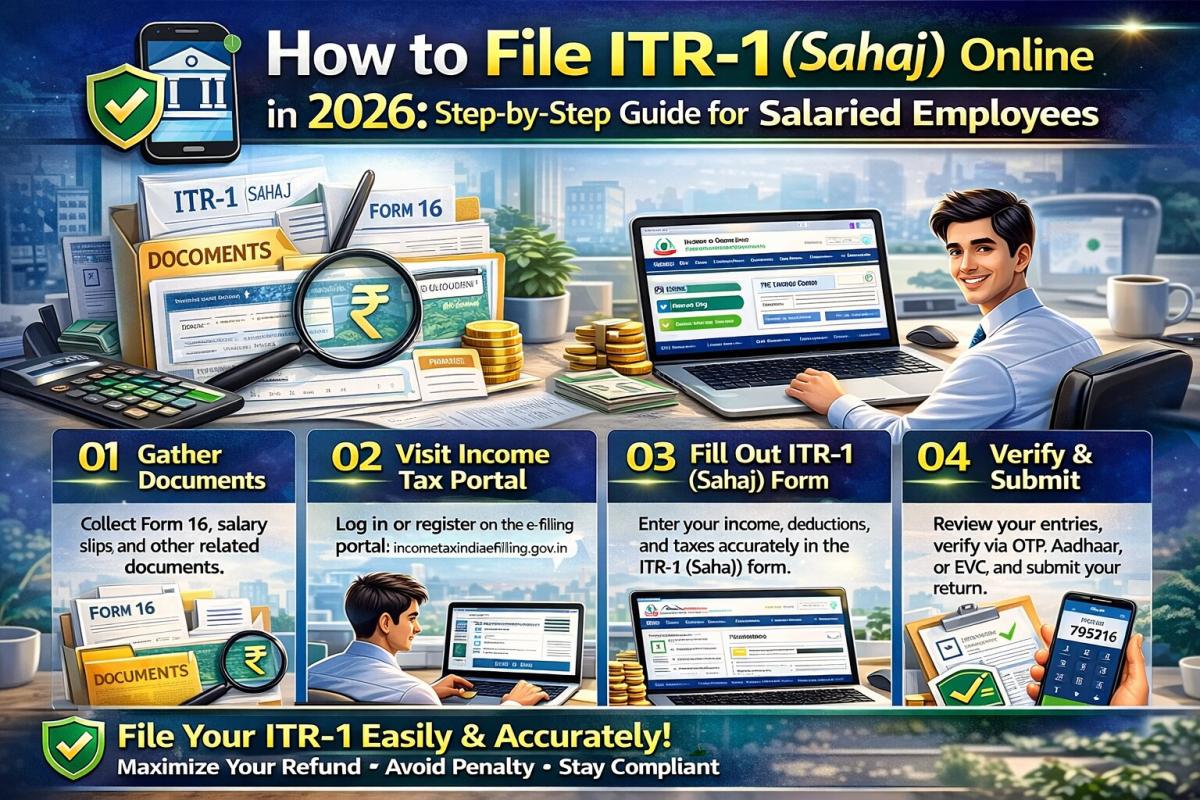
Step-by-Step Guide to File ITR-1 Online
Generally, people think that filing ITR-1 is a very complicated and confusing process. In reality, it is a simple and straightforward process. You simply need to follow a few steps to file your ITR-1 online.
Step 1: Visit Income Tax Portal
To get started with the filing process, visit the official Income Tax Portal. When you're on the website, verify that it is the official and authentic website. Nowadays, scammers have built similar-looking websites that steal your personal information and then commit identity theft and fraud. So, be cautious when submitting or uploading anything on the website.
Step 2: Login or Register
If you're a new user, register yourself with the required details. Enter only the correct details, and then make your account. But if you already have an account, then the process will be much easier for you. You can log in directly to this website. Otherwise, you need to register yourself.
Step 3: Click on "File Income Tax Return"
Once you log in to this website, follow this path to file your ITR-1 online:
- e-File → Income Tax Returns → File Income Tax Return.
Step 4: Enter Assessment Year and Mode of Filing
After you get to the point where the website asks you for the assessment year and the mode of filing, you need to put the assessment year as the current year, and the mode of filing as "Online." Once you choose these parameters, click "Continue."
Step 5: Click on "Start New Filing"
In the next step, search for the "Start New Filing" button on the next page. Never click on the "Edit Existing Return" as it will reset all your progress and data entered till now.
Step 6: Enter Your Status
On the next screen, choose "Individual" as the status for your return filing. Do not enter any other status apart from an individual, as you won't be able to proceed further. ITR 1 applies only to individuals.
Step 7: Select ITR-1 Form
From the list of forms, you need to select "ITR-1." Even if you don't select ITR 1, you will be recommended to file ITR 1 based on your income information entered earlier.
Step 8: Click on 'Let's Get Started'
Click on 'Let's Get Started' and start filling in your information one by one. Once you have filled in all the required information, you will be directed to enter your key information.
Step 9: Choose Filing Reason
Here, you need to enter your reason for filing. You can enter any one of the reasons, such as filing within the due date or filing after the due date.
Step 10: Fill in All Sections Carefully
This is an important part of filing your ITR 1 and you must enter details carefully. You need to read all the sections one by one and enter the necessary information in the portal. Once you have filled in all the sections, you need to read all of them carefully. You should not take your income tax returns lightly, as you may face legal problems in the future.
Step 11: Review Your Return
Before you submit your return, you need to review all your information, drop boxes, and sections carefully.
Step 12: Correct Errors
If you notice any errors, it is best to correct them right away. If you do not do so now, it may never be possible for you to rectify the mistakes in the future without paying a small fee for the corrections.
Step 13: E-Verify Your Return
This is the final step in the process, and here you e-verify your ITR return. If you do not complete this step and submit it, your ITR is considered null and void. You can e-verify using your Aadhaar OTP, net banking credentials, or even your bank account. Choose any one that you are comfortable with. After completing this step of e-verifying your return, you will complete the process of filing your ITR-1.
Common Mistakes to Avoid While Filing ITR-1
ITR-1 is among the most basic of income tax returns. The filing process is simple. However, there are still some errors that people make when filing it. While these mistakes won't lead to any penalties as such, they will definitely slow down the approval process and delay the ITR processing. So, here are some common mistakes you need to avoid:
Not Verifying Form 26AS and AIS
The most common mistake that individuals make is not verifying their Form 26AS or AIS. Most individuals rely on their employer's Form 16, but that is not enough.
Form 26AS shows all your tax deducted at Source (TDS), while AIS shows your entire financial activity, including interest income and investments. There might be a discrepancy in your return with your Form 26AS or AIS. Always verify your income and TDS in Form 26AS before filing your return.
Entering Incorrect Personal Details
There are a few common mistakes that individuals make while filing their returns. These mistakes include entering your PAN number, Aadhaar number, or name incorrectly. These mistakes can cause unnecessary delays in your return processing.
Your personal details should match those on your official documents. Always ensure your personal details are accurate.
Providing Incorrect Bank Details
Your bank account details are very important, especially when you expect a refund. If your bank account details are not accurate, your refund will not be processed. There might be a delay in processing your return as well. Always re-check your bank details while filing your ITR-1.
Missing Out on Deductions
There are instances when taxpayers miss out on claiming deductions that they are eligible to claim. As a result, they end up paying more tax than is required. The common deductions that taxpayers tend to miss out on include:
- Section 80C - LIC, PPF, ELSS, etc.
- Section 80D - Health Insurance
- Section 80TTA - Interest on savings accounts
If taxpayers did not submit the required documents to their employer, they can still claim these deductions while filing their ITR-1.
Choosing the Wrong Tax Regime
Another common mistake taxpayers make is choosing the wrong tax regime without properly calculating it.
The new tax regime has lower tax rates but offers no deductions, while the old regime provides various deductions that taxpayers can claim. As a result, taxpayers end up paying more tax by choosing the wrong tax regime.
Before filing their ITR-1, taxpayers should calculate their tax under both tax regimes and choose the one that is more advantageous.
Not Reporting All Income Sources
There are instances when taxpayers forget to report certain sources of income, such as:
- Interest on savings accounts
- Fixed deposit interest
- Rental income
These are just a few instances when taxpayers tend to forget to report their income. The tax department will send a notice to taxpayers if it finds that they have not reported all their income. As a result, taxpayers should ensure they report their income accurately when filing ITR-1.
Ignoring Validation Errors
The income tax portal has a feature that highlights errors or omissions in taxpayers' returns. There are instances when taxpayers ignore these errors and file their returns anyway.
By ignoring validation errors, taxpayers may end up filing their returns incorrectly or having their returns rejected. As a result, taxpayers should always ensure that they clear all validation errors before filing their returns.
Forgetting to E-Verify
This is one of the biggest mistakes that taxpayers make while filing their returns. Filing of the return is not complete without e-verifying it. If you fail to do this, it will be treated as an invalid return. Always complete the e-verification after filing ITR-1.
Final Thoughts
ITR-1 (Sahaj) is one of the most common and basic forms of income tax returns that can be filed by an individual if their income is up to ₹50 lakhs and they have basic sources of income. However, not every individual is eligible to file this return. One needs to be aware of the filing process and the details that need to be submitted along with the return. The most important thing to remember is that there should not be any errors in the return and all information entered must be accurate.
FAQs
1. Can I edit my ITR-1 return after it has been submitted?
Yes, you can file a revised return.
2. What happens if I provide the wrong account details for the refund?
If incorrect account details are provided for the refund, the refund may not be successful.
3. Do I need to upload the Form 16 while filing the return?
No, it is not necessary to upload the form while filing the return.
4. Can I file ITR-1 using my mobile phone?
Yes, the income tax portal is mobile-friendly and can be accessed from anywhere.
5. What if my employer does not provide the Form 16?
Even if the employer does not provide the Form 16, the return can be filed by using the salary slips and the details from the Form 26AS.
6. Is it mandatory to link my PAN with my Aadhaar Card while filing the return?
Yes, it is mandatory to link the PAN with the Aadhaar Card.
7. Can I file my return after the due date?
Yes, the return can be filed after the due date by paying a fee for the belated return.
8. How do I check the refund status of my return?
The refund status can be checked from the income tax portal or the NSDL website by providing the PAN and the assessment year details.
Related Blogs
Published on Mar 27, 2026
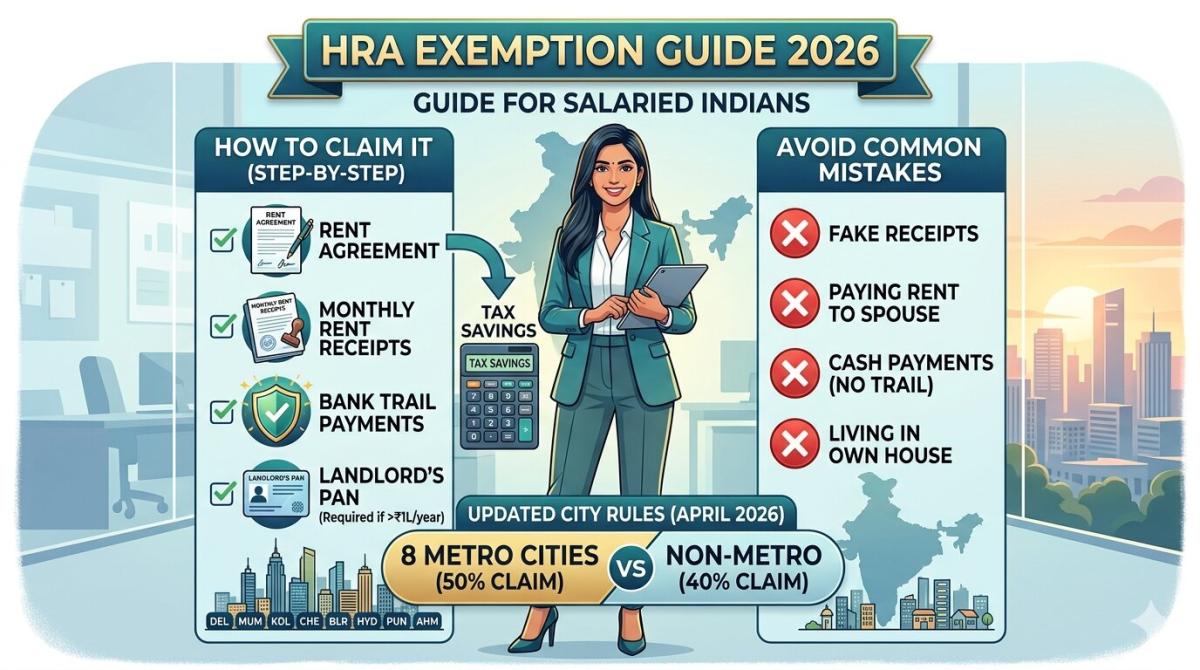
HRA Exemption: How Salaried Indians Can Claim It and Avoid Common Mistakes
Learn how HRA exemption works, how to calculate it, and common mistakes salaried Indians make. Step-by-step guide with examples for FY 2025-26.
Priya Nair
Senior Compliance Editor at IFSC.co
Published on Mar 26, 2026
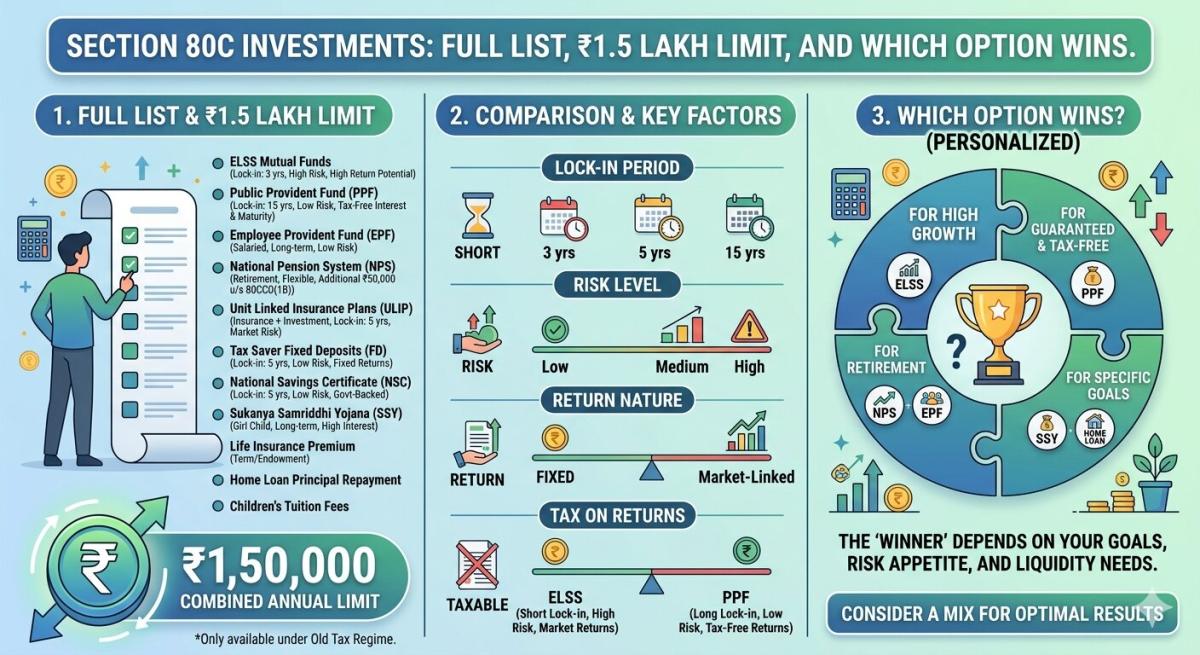
Section 80C Investments: Full List, ₹1.5 Lakh Limit, and Which Option Wins
Save tax with Section 80C investments. Explore the full list, ₹1.5 lakh limit, and compare options to choose the best tax-saving investment for you.
Priya Nair
Senior Compliance Editor at IFSC.co
Published on Mar 09, 2026
New Tax Regime vs Old Tax Regime: A Real-Numbers Comparison for Salaried Indians (FY 2025-26)
New vs old tax regime FY 2025-26 — compare real tax on ₹6L, ₹10L & ₹15L salaries. See who pays zero tax and find your break-even point.
Arjun Sharma
Content Lead – Banking & Payments
calculate Financial Calculators
EMI Calculator
FD Calculator
GST Calculator
Lumpsum Calculator
Mutual Fund Returns Calculator
PPF Calculator
RD Calculator
SIP Calculator
SWP Calculator
article Latest Blog Posts
ELSS vs PPF vs NPS: Which Tax-Saving Investment Gives the Best Returns?
Compare ELSS vs PPF vs NPS to find the best tax-saving investment. Understand returns, lock-in periods, and features to choose what suits your goals.
SIP & Investing • 11 MINS READ
How to Start SIP with ₹500 Per Month: Beginner's Guide to Mutual Funds
Learn how to start a SIP with ₹500 per month in mutual funds. Simple beginner’s guide to investing, building wealth, and growing money with small steps.
SIP & Investing • 13 MINS READ
Senior Citizen FD Rates 2026: Which Banks Offer the Highest Interest?
Compare senior citizen FD rates in 2026 and find which banks offer the highest interest. Learn about returns, tenures, and tips to choose the best FD.
FD, PPF & Savings • 12 MINS READ
Sukanya Samriddhi Yojana (SSY): Interest Rate, Rules & Calculator Guide 2026
Learn about Sukanya Samriddhi Yojana (SSY) including eligibility criteria, required documentation, step by step application process, tax benefits explanation and comparison b/w SSY, PPF and FD
FD, PPF & Savings • 11 MINS READ
2 reasons why online banking is important in today’s COVID-19 situation
Discover why online banking became essential during COVID-19. Learn how digital banking ensured safety, convenience, and uninterrupted financial services.
Digital Banking • 4 MINS READ