What Causes Silent Bank Transaction Failures Without Alert
Discover the key causes of silent bank transaction failures, including network timeouts, API issues, system delays, and how banks resolve these hidden payment errors.

Table of Contents
- Introduction
- How a Bank Transaction Actually Works
- What Is a Silent Transaction Failure
- Core Causes of Silent Transaction Failures
- Comparison Table: Silent Failure vs Visible Failure
- Real World Patterns Observed in Silent Failures
- How Banks Handle These Failures Internally
- How Users Can Detect Silent Failures
- Preventive Measures to Reduce Risk
- FAQ Section
- Conclusion
Introduction
Digital banking has made money transfers feel instant and effortless, yet behind every successful transaction lies a complex chain of systems, validations, and network communications. Occasionally, something goes wrong in this chain without notifying the user. The result is what many people describe as a silent bank transaction failure, where money does not reach the intended destination, and no clear alert is received.
Understanding why this happens requires looking beneath the surface of modern banking infrastructure. Silent failures are not random. They are the outcome of technical limitations, system design choices, network dependencies, and regulatory safeguards that do not always communicate effectively with end users.
How a Bank Transaction Actually Works
A typical bank transfer is not a single action. It is a sequence of events involving multiple systems:
- User initiates a transaction through an app or website
- The payment request goes to a payment gateway
- The gateway communicates with banking networks
- The sender bank verifies balance and authorization
- The receiving bank processes the credit
- Confirmation signals are sent back through the chain
According to insights from the Bank for International Settlements, modern payment systems rely on layered communication protocols where each stage must succeed for the transaction to complete. Even a small disruption at any stage can create inconsistencies without immediate notification.
What Is a Silent Transaction Failure
A silent failure occurs when:
- The transaction does not complete successfully
- No immediate error message is shown
- The user does not receive a notification
- Funds may be temporarily held or reversed later
This differs from visible failures where users receive clear alerts such as insufficient balance or invalid account details. Silent failures are harder to detect because they create ambiguity rather than clarity.
Core Causes of Silent Transaction Failures
1. Network Timeouts Between Systems
One of the most common causes is a timeout during communication between systems. When a payment request is sent, each system waits for a response within a specific time window. If the response takes too long, the system may cancel the request silently.
Research from the National Payments Corporation of India highlights that high traffic periods can increase latency, leading to incomplete confirmations. In such cases, the transaction might actually be processed partially, but the confirmation signal fails to return.
2. Payment Gateway Communication Breakdowns
Payment gateways act as intermediaries between users and banks. If a gateway successfully sends a request but fails to receive acknowledgment, it may not notify the user immediately.
According to documentation from Reserve Bank of India, asynchronous communication between gateways and banks can result in temporary inconsistencies where transaction status remains unclear until reconciliation occurs.
3. Core Banking System Delays
Core banking systems process transactions in real time or near real time, but under heavy load, they may switch to queued or batch processing. During such times:
- Transactions may be accepted but not processed immediately
- Status updates may not reach the user interface
- Delays may appear as silent failures
Studies referenced by the World Bank show that infrastructure strain during peak usage is a major contributor to transaction inconsistencies.
4. API Failures and Integration Issues
Modern banking relies heavily on APIs. If an API fails silently due to internal errors or incomplete responses, the system may not display an error to the user.
Examples include:
- Partial API responses
- Incorrect response formatting
- Missing acknowledgment signals
According to International Organization for Standardization standards, financial messaging systems must follow strict protocols, but implementation gaps can still lead to communication mismatches.
5. Server Synchronization Problems
Banks operate on distributed systems with multiple servers. If these servers are not perfectly synchronized:
- One server may record the transaction
- Another may fail to update the status
- The user interface may display outdated information
This is often referred to as eventual consistency, a concept discussed in depth by IBM.
6. Third Party Dependency Failures
Many transactions depend on third party services such as:
- Payment processors
- Telecom networks
- Authentication providers
If any of these services fail silently, the transaction chain breaks without immediate visibility. For example, authentication delays in OTP delivery systems can cause transactions to expire without user awareness.
7. Fraud Detection and Risk Filters
Banks use automated systems to detect suspicious activity. If a transaction is flagged:
- It may be temporarily blocked
- It may not proceed further
- The user may not receive immediate notification
Guidelines from the Financial Action Task Force emphasize cautious handling of flagged transactions, which sometimes results in silent delays instead of explicit rejections.
8. Mobile App and UI Failures
Sometimes the issue is not with the transaction itself but with the app interface:
- The app may crash before showing confirmation
- Notifications may fail due to device settings
- Background processes may not sync properly
Documentation from Google notes that app level interruptions can prevent transaction updates from being displayed even when backend processing is complete.
Comparison Table: Silent Failure vs Visible Failure
Key Differences Between Transaction Failure Types
|
Aspect |
Silent Failure |
Visible Failure |
|
User Notification |
No immediate alert |
Clear error message |
|
Transaction Status |
Unclear or pending |
Explicitly failed |
|
Resolution Time |
Often delayed |
Immediate clarity |
|
Common Causes |
Network issues, API delays, system sync problems |
Invalid inputs, insufficient balance |
|
User Action Required |
Wait or manually check |
Retry immediately |
Real World Patterns Observed in Silent Failures
Several recurring patterns appear in banking ecosystems:
- Peak hour congestion leads to delayed confirmations
- Cross bank transactions have higher failure ambiguity
- Mobile network instability increases silent errors
- International transfers show more latency related issues
Research published by the SWIFT indicates that cross system communication is one of the most fragile points in transaction processing.
How Banks Handle These Failures Internally
Banks use reconciliation systems to identify mismatches. These systems:
- Compare sent and received transaction logs
- Detect incomplete transactions
- Automatically reverse or complete them
According to guidelines from European Central Bank, reconciliation processes ensure that even silent failures are eventually corrected, though not always instantly.
How Users Can Detect Silent Failures
Even without alerts, users can identify issues by:
- Checking transaction history
- Monitoring account balance changes
- Reviewing bank statements
- Waiting for delayed confirmations
Delayed refunds or reversals are often the final indicator that a silent failure occurred.
Preventive Measures to Reduce Risk
To minimize silent transaction failures:
- Use stable internet connections
- Avoid peak transaction hours
- Keep banking apps updated
- Double check transaction details
- Enable SMS and email notifications
These steps do not eliminate risk but significantly reduce the chances of unnoticed failures.
FAQ Section
Why does money sometimes get debited but not credited
This usually happens due to communication breakdown between banks. The debit may succeed while the credit confirmation fails, leading to temporary inconsistency.
How long does it take to resolve silent failures
Most cases are resolved within a few hours to a few days depending on the banking system and reconciliation cycles.
Can silent failures lead to permanent loss of money
No, regulated banking systems ensure that funds are either credited or reversed after reconciliation.
Why are there no alerts in such cases
Alerts depend on successful communication between systems. If the notification process itself fails, users may not receive updates.
Are silent failures more common in certain types of transactions
Yes, they are more common in cross bank transfers, high traffic periods, and transactions involving multiple intermediaries.
What should be done if a transaction shows no status
Users should wait for a reasonable time, then contact the bank with transaction details for investigation.
Conclusion
Silent bank transaction failures are not random glitches but predictable outcomes of complex system interactions. They occur when communication between multiple layers breaks down without generating a clear signal for the user. From network timeouts and API inconsistencies to fraud detection systems and server synchronization delays, each factor contributes to a fragile chain where even minor disruptions can create confusion.
Modern banking systems are designed with safeguards that ensure eventual correction through reconciliation processes, meaning that funds are rarely lost permanently. However, the lack of immediate transparency can create uncertainty for users who rely on real time confirmations.
Understanding these underlying mechanisms provides clarity and confidence when such situations arise. By recognizing the patterns, monitoring transactions carefully, and using reliable digital practices, users can navigate these issues more effectively while trusting that the system is designed to resolve discrepancies even when it does so silently.
Related Blogs
Published on Apr 28, 2026
How Banks Verify Account Holder Identity Before Transfer
Learn how banks verify account holder identity before transfers using KYC, OTP, biometrics, and real-time fraud detection to ensure secure and compliant digital transactions.
Priya Nair
Senior Compliance Editor at IFSC.co
Published on Apr 28, 2026
Real Time Bank Transaction Authentication Process Explained
Understand how real-time bank transaction authentication works using OTP, biometrics, encryption, and AI-driven fraud detection to secure digital payments instantly.
Priya Nair
Senior Compliance Editor at IFSC.co
Published on Apr 09, 2026
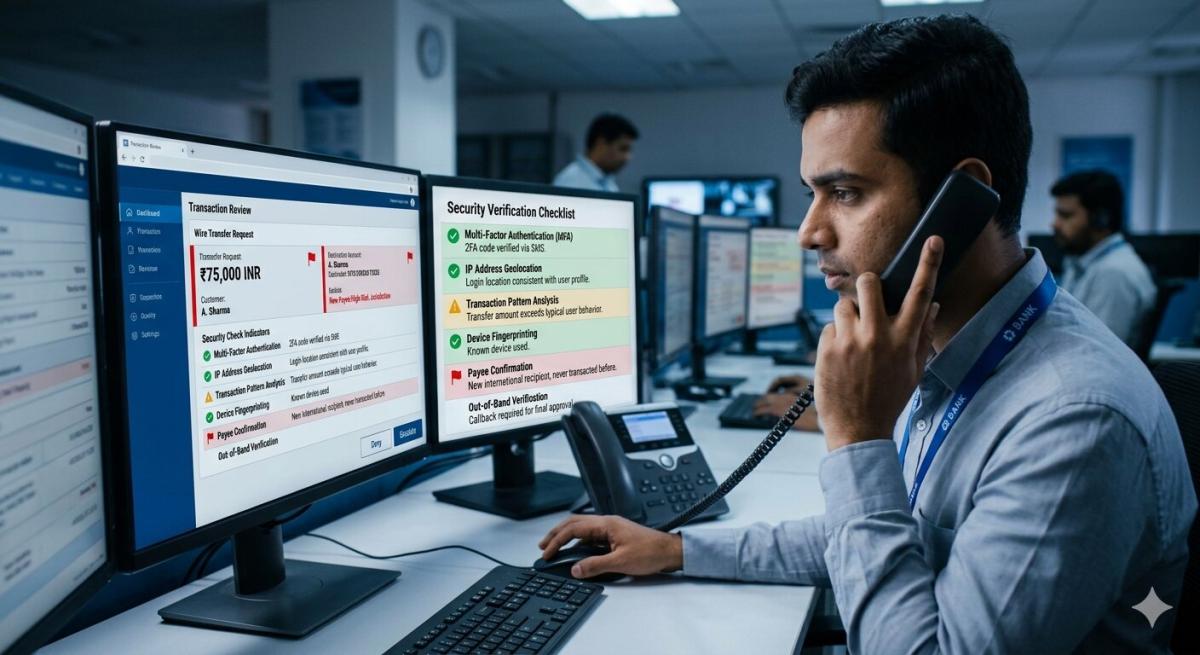
Fraud Prevention: Security Checks Before Bank Transfer Approval
Learn how banks use KYC verification, AI-powered fraud detection, transaction monitoring, MFA, AML compliance, and human oversight to secure bank transfers and prevent fraud in 2026.
Priya Nair
Senior Compliance Editor at IFSC.co

Published on Apr 09, 2026
Risk Assessment Before Processing Large Transactions: Prevent Fraud & Secure Funds
Learn why risk assessment before processing large transactions is essential in 2026, including KYC, AML, source of funds checks, AI monitoring, and fraud prevention strategies.
Priya Nair
Senior Compliance Editor at IFSC.co

Published on Apr 09, 2026
Understanding Bank Transaction Limits: Why They Keep Your Money Safe
Learn why banks impose transaction limits, how they prevent fraud and money laundering, and how daily, weekly, and channel-based limits help protect your money in 2026.
Priya Nair
Senior Compliance Editor at IFSC.co
calculate Financial Calculators
EMI Calculator
FD Calculator
GST Calculator
Lumpsum Calculator
Mutual Fund Returns Calculator
PPF Calculator
RD Calculator
SIP Calculator
SWP Calculator
article Latest Blog Posts
ELSS vs PPF vs NPS: Which Tax-Saving Investment Gives the Best Returns?
Compare ELSS vs PPF vs NPS to find the best tax-saving investment. Understand returns, lock-in periods, and features to choose what suits your goals.
SIP & Investing • 11 MINS READ
How to Start SIP with ₹500 Per Month: Beginner's Guide to Mutual Funds
Learn how to start a SIP with ₹500 per month in mutual funds. Simple beginner’s guide to investing, building wealth, and growing money with small steps.
SIP & Investing • 13 MINS READ
Senior Citizen FD Rates 2026: Which Banks Offer the Highest Interest?
Compare senior citizen FD rates in 2026 and find which banks offer the highest interest. Learn about returns, tenures, and tips to choose the best FD.
FD, PPF & Savings • 12 MINS READ
Sukanya Samriddhi Yojana (SSY): Interest Rate, Rules & Calculator Guide 2026
Learn about Sukanya Samriddhi Yojana (SSY) including eligibility criteria, required documentation, step by step application process, tax benefits explanation and comparison b/w SSY, PPF and FD
FD, PPF & Savings • 11 MINS READ
2 reasons why online banking is important in today’s COVID-19 situation
Discover why online banking became essential during COVID-19. Learn how digital banking ensured safety, convenience, and uninterrupted financial services.
Digital Banking • 4 MINS READ